German Panzer IV Medium Tank
German Vehicle Designations
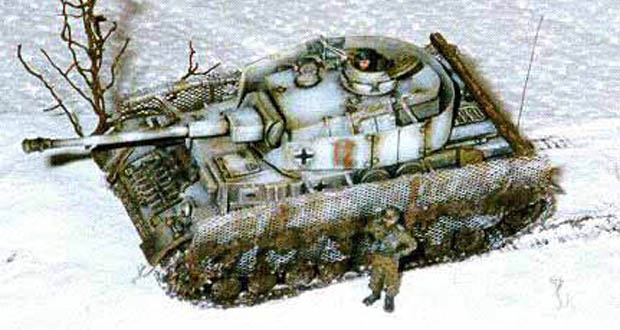
German Panzer IV Ausf. G3 medium tank from the collection of Jim Gordon. The ESCI vehicle is shown in winter camouflage.
The table lists vehicle designations of Panzerkampfwagen IV tanks in German and Axis service. Panzerkampfwagen IV was originally designed as a support vehicle. Panzer IV platoons were deployed behind the attacking Panzer I, Panzer II, and Panzer III platoons, a position which enabled them to provide long-range direct HE fire against enemy anti-tank gun positions.
Panzer IV made the transition to a main battle tank in 1943, when Panzer III had become obsolete. Panzer IV and Panzer III actually switched roles: Panzer IV Ausf. F2 upgraded to the long 7.5 cm L.43 gun, and Panzer III Ausf. N received the short 7.5 cm L.24 of the Panzer IV Ausf. F1 support vehicle. Panzer IV was the only German tank to remain in production throughout the war.
| Panzer IV Type | 1:72 Model | 1:76 Model |
|---|---|---|
| Pz.Kpfw. IV Ausf. A | IBG W-004 | – |
| Direct fire support vehicle mounting the 7.5 cm L.24 Sturmkanone 37. Panzer IV Ausf. A had 20 mm of armour all around, an internal gun mantlet, vision slits in the commander’s cupola, and a staggered front upper hull plate. The vehicle had a maximum road speed of 24 mph. There is a picture of at least one Panzer IV. Ausf. A serving with Rommel in North Africa. | ||
| Pz.Kpfw. IV Ausf. B | IBG W-008 | Crusader Models CMB50a |
| As above, except that it was equipped with a more reliable engine. | ||
| Pz.Kpfw. IV Ausf. C | IBG W-007 | Hinchliffe 20/193 |
| As above, but with a number of additional refinements. | ||
| Pz.Kpfw. IV Ausf. D | IBG W-009 | Crusader Models CMB50b |
| Direct fire support vehicle mounting the 7.5 cm L.24 Sturmkanone 37. Panzer IV Ausf. D had 30 mm of frontal armour, and an external gun mantlet. Deployed with Rommel in Africa. | ||
| Pz.Kpfw. IV Ausf. E | – | – |
| Direct fire support vehicle mounting the 7.5 cm L.24 Sturmkanone 37. Panzer IV Ausf. E had additional 30 mm plates bolted onto the hull front, increasing its frontal armour to 60 mm. The turret front was not be upgraded, because the ventilator openings located there had to be kept open. Deployed with Rommel in Africa. | ||
| Pz.Kpfw. IV Ausf. F1 | CDC | Airfix 02308 |
| Direct fire support vehicle mounting the 7.5 cm L.24 Sturmkanone 37. Panzer IV Ausf. F1 had 50 mm of frontal armour, and the commander’s cupola received bullet-proof glass vision ports. | ||
| Pz.Kpfw. IV Ausf. F2 | Hobby 2000 | Airfix 02308 |
| Field upgrade of the F1, fitted with the longer L.43 gun. The British in North Africa referred to the F2 as the Mark IV Special. It was this vehicle which took on the role of main battle tank when the Panzer III had become obsolete. Available 7.5 cm L.24 Sturmkanone guns were mounted in StuG. III Ausf. D assault guns, Panzer III Ausf. N tanks, Sd.Kfz. 250/8 and 251/9 half-tracks which now adopted the fire support role previously fulfilled by the Panzer IV. | ||
| Pz.Kpfw. IV Ausf. G1 | – | – |
| Field upgrade of the F2, using a bolted or welded on 30 mm applique armour kit which gave the vehicle a total of 80 mm of frontal armour, except that the turret front remained at 50 mm of armour. The additional armour made the vehicle nose-heavy, and it resulted in excessive wear of the leading bogie wheels. Panzer IV Ausf. G are easy to spot in photos, they show a noticeable tilt forward, especially on soft ground. This vehicle retained the L.43 gun of the F2, and the rubber bogie wheels. | ||
| Pz.Kpfw. IV Ausf. G2 | – | – |
| Same as the G1, but mounting the longer L.48 gun. Nose-heavy, vehicle tilts forward noticeably. | ||
| Pz.Kpfw. IV Ausf. G3 | ESCI | 1:87 ROCO |
| Standard factory upgrade of the F2, with 80 mm of frontal armour, and the L.48 gun. Nose-heavy. The suspension bogie wheels were redesigned to correct this problem, but the vehicle still tilted forward noticeably. | ||
| Pz.Kpfw. IV Ausf. H | ESCI | Fujimi 76012 |
| Factory upgrade of the G3, with improved front suspension. The bogie wheels were again redesigned to correct the excessive tire wear, but the problem persisted. The vehicle was fitted with turret and side skirts as a protection against hollow charge warheads. | ||
| Pz.Kpfw. IV Ausf. J | CDC | – |
| Same as the H series, but with solid metal front bogie wheels. US and Allied bombing raids against bearing factories in Germany resulted in production problems which cost the Panzer IV its turret traverse motor. The hand-cranked turret of the Ausf. J was a significant disadvantage in combat. The vehicle mounted a Nahverteidigungswaffe close defense weapon. | ||
| Pz.Kpfw. IV Ausf. K1 (Projection) |
n.a. | n.a. |
| It is a mystery why the Panzer IV series was never upgraded to Ausf. K, using the sloped hull front of the Jagdpanzer IV. With 80 mm of sloped frontal armour, the Panzer IV Ausf. K would have extended the useful life of the Panzer IV series of tanks. The reduction in nose weight solves the bogie wheel problem as well as the associated transmission and steering problems which plagued the uparmoured Panzer IV. This modification could have been issued as a field workshop upgrade kit for the Panzer IV Ausf. G to J series. Doing so would have been easier and cheaper than designing and introducing the new Panzer V (Panther) series. This projected vehicle may be converted using parts from a standard Panzer IV and the Jagdpanzer IV, it would be interesting to test in a simulation game. | ||
| Pz.Kpfw. IV Ausf. K2 (Projection) |
n.a. | n.a. |
| Standard factory version of the K1, fitted with smoke grenade dischargers. | ||
| Pz.Kpfw. IV Ausf. L (Projection) |
n.a. | n.a. |
| This projected vehicle should have had the entire hull front redesigned to 80 mm of sloped armour. The corresponding weight saving would have solved the suspension problems, and it would have allow the turret front to be uparmoured to 80 mm. The gun should have received a fume extractor on the barrel, copied directly from a captured American M36 Jackson tank destroyer. The fume extractor is a prerequisite for the turret uparmour conversion, otherwise the built-up of smoke inside the turret would render the tank inoperable very quickly. The Panzer IV had ventilator openings in the turret front which had to be kept open in combat, effectively preventing a turret uparmour conversion. | ||
The table list 1:72 and 1:76 scale model kits which match the official vehicle designations. Not every Panzerkampfwagen IV is available in miniature yet, but it is hoped that the remaining gaps may be filled eventually.
Historical Employment
- Germany, 1937–1945
- Romania, from September 1942
- Hungary, from September 1942
- Italy, from May 1943
- Turkey, from May 1943
- Bulgaria, from February 1943
- Spain, from November 1943
- Independent State of Croatia, from late 1944
- Finland, 1946–1962
- Syria, 1962–1967
Andrew Mark Reid