BTR-152A self-propelled Anti-Aircraft Gun
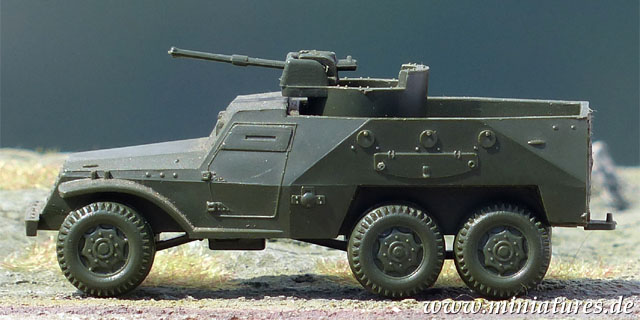
The Soviet BTR-152A self-propelled anti-aircraft gun, introduced in 1951, its successor the BTR-152D introduced in 1955, and its successor the BTR-152E of 1957, served the anti-aircraft forces of the Warsaw Pact and its allied armies in Africa, South America, and Asia. The vehicles, based on the armoured 6×6 chassis of the ZIL-157 truck, were available in the ZPTU-2 variant with a 14.5 mm twin anti-aircraft gun, the ZPTU-4 variant with a 14.5 mm quadruple anti-aircraft gun in a manually rotated tubular frame mount, and the 23 mm ZU-23-2 twin anti-aircraft gun.
Available Scale Model Kits
- BTR-152A with ZPTU-2, 1:100 Roskopf 12
- BTR-152A/D with ZPTU-4 (1955), 1:35 Unimodels 231
- BTR-152E with ZPTU-2 (1959), 1:35 Skif 210
- BTR-152E with ZU-23-2, 1:35 Skif 208
- BTR-152E with ZPTU-2 (1959), 1:72 MAC 72004
Historical Employment
- BTR-152A served in Afghanistan, Albania, Algeria, Bulgaria, Cambodia, China (Type 56), Congo, Cuba, Czechoslovakia, East Germany, Egypt, Finland, Hungary, India, Iran, Iraq, North Korea, Poland, Romania, the Soviet Union, Syria, and many other countries.
The BTR-152A, BTR-152D, and BTR-152E self-propelled anti-aircraft guns were important support vehicles for the Warsaw Pact and its allies in Africa, South America, and Asia.