Sioux Camp
Atlantic 1:72 Scale Antique Figure Review

At first glance, the Atlantic 1:76 scale Sioux Camp looks very interesting. Upon closer inspection, however, 80 percent of the figures exhibit significant flaws that would need to be corrected before they could be incorporated into a diorama. On the packaging, Atlantic labels these Sioux figures as H0 scale (1:87). This would imply an average height of an astonishing 23 × 87 = 2 meters. According to contemporary accounts, Sitting Bull — tribal chief and medicine man of the Hunkpapa Lakota Sioux — was supposedly impressively tall. In photographs, however, Sitting Bull appears about 10 cm shorter than Buffalo Bill Cody, who stands beside him and was reportedly 180 to 185 cm tall.
Miniatures in 10 Poses – 23 mm equal 166 cm height
- Chief with Peace Pipe, seated
- Medicine Man with Drum, seated
- Sioux with Spear, seated
- Sioux with Enfield Carbine, seated
- Sioux, chopping Wood
- Sioux, caring for his Horse
- Two Sioux Hunters with Prey
- Sioux Woman, curing Leather
- Sioux Woman, cooking
- Young Horse
- Tipi
- Camp Fire
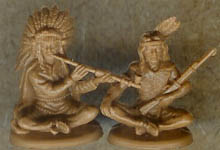
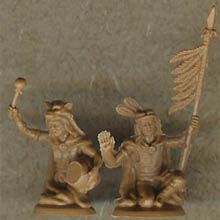
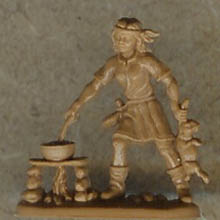
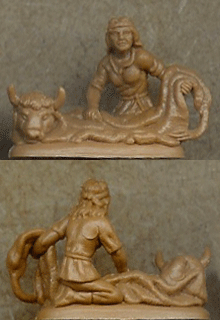
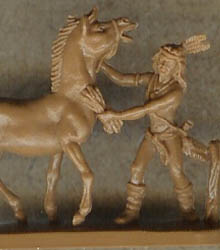
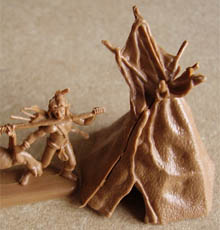
One of the Sioux warriors appears to be armed with a British Enfield carbine — sourced from Confederate military stocks — which can be distinguished from the Spencer and Sharps carbines used by the U.S. Cavalry by its longer stock and two barrel bands. The tribal elder‘s peace pipe is an astonishing 114 cm long, yet unusually unadorned. Peace pipes belonging to the Lakota (Sioux), for instance, were typically richly decorated with braided horsehair and beautiful feathers.
The seated Sioux warriors are dressed in a predominantly realistic manner, with the exception of their atypical cloaks, which feature a central clasp. With a bit of effort, these cloaks could be altered to resemble blankets draped over the shoulders.
Instead of a loincloth, the standing warriors wear a sort of diaper that is passed from the back between the legs and secured in the front with a knot. Such undergarments certainly did not exist among the Sioux; otherwise, their enemies would likely have fallen out of their saddles from laughter. This error can be corrected quite easily by adding a loincloth made of paper.
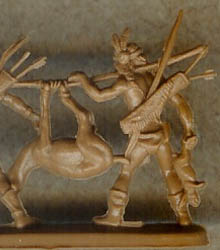
The slain deer appears to be still alive; at any rate, its hind legs are not relaxed but visibly bent, its back is arched, and its muscles are clearly tense — as if the animal might, at any moment, kick out backward and free itself from its bonds.
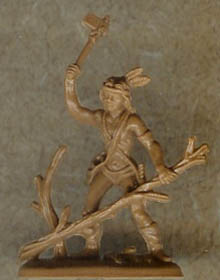
The Sioux woodchopper clearly has no grasp of physics. He might manage to strike the log with his tomahawk, but because the wood is positioned at an angle, it will simply absorb the blow, rendering it ineffective. If he’s lucky, his tomahawk — held together by leather thongs or willow withes — will fall apart on the first strike; if not, the blade will glance off the wood and strike the warrior in his right leg. This Sioux is likely acting so foolishly simply because, as an adult man, he hasn’t had to gather firewood for a very long time. Warriors hunted, fought, or trained, while women, children, and the elderly collected wood — or dried buffalo chips — near the camp to use as fuel. Hunter-gatherers have no need to chop wood at all, as they move on to the next campsite long before the well-dried fuel lying on the ground — which can be gathered with minimal effort — has been exhausted.
The woman at the camp fire is one of the worst cooks in her tribe. The flames of the cooking fire burn so intensely that she cannot stop stirring the soup for even a second. Yet, she must stir with great care, as the crude, fieldstone structure of the hearth would collapse at the slightest touch. The Sioux woman appears so overwhelmed by this task that — seemingly lost in thought — she holds a live hare in her hand, its front legs tensed in preparation for defense or flight. She may not be much of a cook, but when it comes to fashion, she is far ahead of other American women: the miniskirt would not be invented by the British fashion designer Mary Quant until 1962 —well over a century after this snapshot was taken.
The second Sioux woman is working on a buffalo hide without having first removed the animal’s head, tail, or hooves. Presumably, the sculptor added the head so that the undersized scrap of material would even be recognizable as a buffalo hide. The squaw has draped the bloody, foul-smelling hide partly over her lap — surely ruining the lovely outfit she wore the previous year, if indeed she is wearing one at all. Viewed from behind, the figure appears naked from the hips down, or perhaps clad in very tight-fitting stretch pants tucked into unusual, mid-calf boots. In reality, Sioux women wore long dresses and leggings made of elk or deerskin — garments that did far less to accentuate the female form than the provocatively tight-fitting sweatshirts worn by these Atlantic figures.
The only horse in this Sioux camp, with a height at the withers of just 115 cm, is far too small to be a full-grown riding horse. It appears to be a young horse, which its owner is currently grooming — or perhaps cleaning — using a large bunch of grass or vegetation. The Appaloosa horses, originally bred by the Nez Perce in North America, typically stand between 142 and 165 cm tall today.
In a tipi measuring only 28 mm, no Sioux could stand upright, let alone live inside with his family. At this scale, tipis — or comparable U.S. Army 12-foot Sibley tents — should actually be 51 to 59 mm tall. A Sibley tent had a diameter of 18 feet, which would be 76 mm in 1:72 scale. Consequently, this tipi model is actually 1:120 scale — the scale used for TT-gauge model railways. While this mini-tipi might be useful as a background element in a diorama, it looks ridiculously small when placed directly next to 1:72 scale figures. Furthermore, the tent covers are not stretched taut over the poles, as was customary for actual tipis; the numerous large folds and indentations would collect rainwater, which would then seep through the material into the interior.
Given the many design flaws, the number of realistic-looking figures in this Atlantic 1:72 scale Sioux Camp is quite low. The seated figures are the most usable; two of them could even be positioned with their backs to the viewer, which would conveniently hide the unusual clasp on their cloaks.