Celtiberians
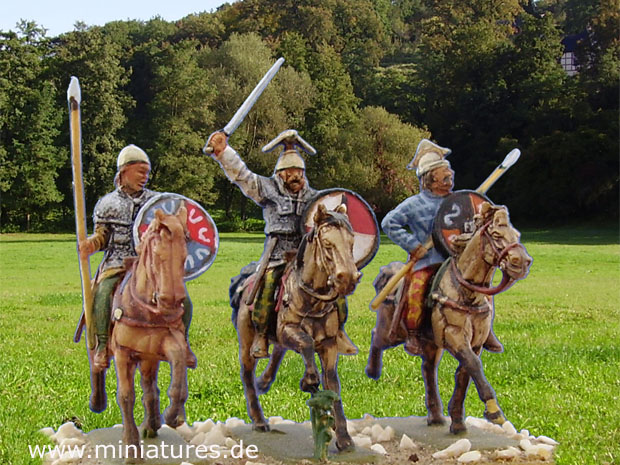
Celtiberians (Latin: Celtiberi), a people of ancient Spain (Iberia), originated from the intermingling of migrating Celts and the native Iberians, hence the name given to them by the Greeks; they themselves only knew the names of the individual tribes: Arevaci, Murbogi, Berones, Peledones, Lusones, Belli, and Dittans. The Celtiberians inhabited the high plateau of the upper Iberian River. The land was crisscrossed by steep mountain ranges, rugged and barren, and the Celtiberians were the most warlike people in all of Spain. They had only a few cities, such as Clunia, Segovia, and Numantia, and mostly lived in villages or as semi-nomadic herders, since the land was almost exclusively suitable for sheep grazing. They retained the Celtic physical type (blond hair, blue eyes, and tall stature) but adopted Iberian customs, dress, weaponry, and language. Of all the peoples of Spain, the Celtiberians caused the Romans the most trouble, despite initially having aided them against the Carthaginians. Their defection led to the downfall of the brothers Publius Cornelius and Gnaeus Cornelius Scipio in 212 BC. Marcus Porcius Cato the Elder first took a strong stand against them in 195 BC. Tito Sempronius Gracchus destroyed many of their strongholds in 179 BC, effectively bringen them under control. The Romans suffered many defeats at the hands of the Numantians; even the destruction of Numantia in 133 BC did not break the Celtiberians‘ proud spirit of freedom. Under Sertorius, they resumed the war, and only after his downfall was their subjugation complete. Roman language, clothing, and customs then took hold, and the land became part of the Conventus Cluniensis of the Roman province of Hispania Tarraconensis.
Celtiberian Miniatures
- Celtiberians, 1:32 HäT 9211
- Celts
- Iberians
Bibliography
- Garofalo: I Celti nella peninsola iberica (in La Cultura, 1900)
- Phillips: Die Wohnsitze der Kelten auf der Pyrenäischen Halbinsel (Wien 1872)
Source: Meyers Großes Konversations-Lexikon, 6. Auflage 1905–1909