Mould Shift
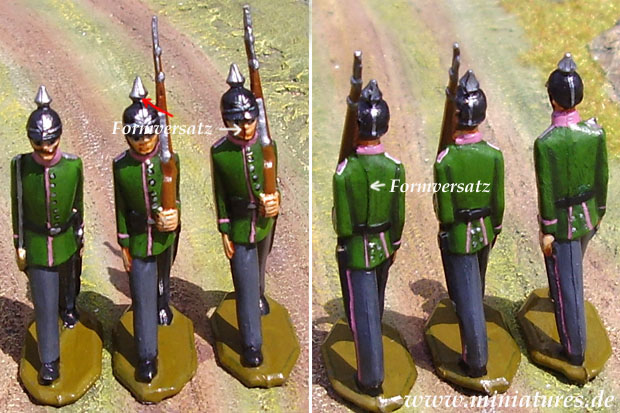
Mould shift (mould slip) is a geometric defect in castings, caused by the two mould halves being slightly misaligned during the casting process. Before casting, the upper and lower sections of a mould must be fitted together precisely and secured with screws, clamps, or rubber bands to ensure that the liquid casting material remains within the mould and does not leak through the parting line. To this end, one mould half features conical or hemispherical pins designed to engage with corresponding recesses in the opposing mould half, thereby enhancing the precision of the fit.
Silicone and rubber moulds can warp during casting — particularly when used without a mould board — and subsequently fail to fit together precisely. With steel or aluminum moulds, however, mould misalignment can be largely eliminated, provided that both mould halves are heated evenly and suitable clamps are used.
The illustration shows mould misalignment on fusiliers of the Duchy of Anhalt, which were home cast in rubber moulds from the Schildkröt “Zinnbrigade” series. The figure on the left flank has been rendered almost unusable due to severe mould misalignment affecting its face and back. The fusilier in the center exhibits slight vertical mould misalignment on his Pickelhaube helmet.