Polystyrene Sheet from Yoghurt Cups
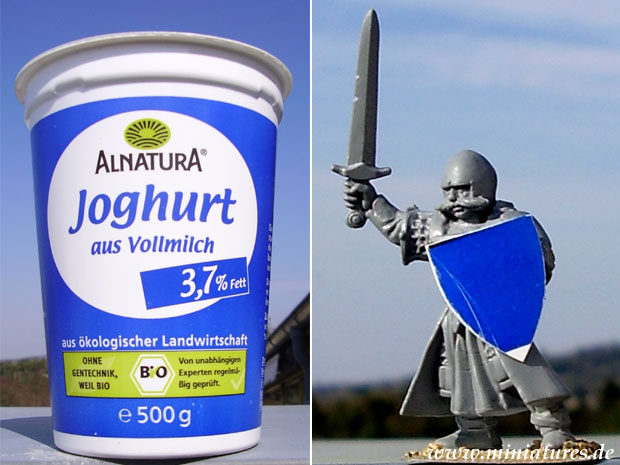
A 500 g yoghurt container from Alnatura yields approximately 275 cm² of polystyrene with a thickness of 0.5 mm. After removing the bottom, the container can be rolled out, but not permanently flattened, as the material immediately returns to its original shape when released. This idiosyncratic polystyrene is somewhat difficult to work with, but it provides curved components for many interesting applications in model making, such as shields, shield bosses, hubcaps, lamp or fruit bowls, radar screens, sirens, barrel hoops, buckets, pots and pot lids, pans, plates, helmets, medals, brooches, fittings, bracelets, belt buckles, greaves, neck guards, horse armor, or the lenticular canteens of the Confederate Army, and much more. Lentil-shaped components can be easily turned out of the thin polystyrene using a 10 to 15 mm hole punch. If necessary, the curvature of the polystyrene can be eliminated by gluing two layers of the material together on the inwardly curved surfaces and pressing them firmly together until the glue has set.
The thin polystyrene of a yoghurt cup can be easily worked with nail scissors. To cut out the long, narrow, pointed Norman shields of the 11th and 12th centuries, place a scale paper template on the chosen polystyrene sheet and carefully cut around it with the nail scissors. Compared to the thick shields of commercially available plastic or metal figures, homemade shields made from a yoghurt cup appear very thin and fragile, even though the knight wielding them is practically still carrying around a solid door leaf, which, at a scale of 1:72, is a good 36 mm thick. Especially with stocky 28 mm figures, it may be necessary to construct the shield from two laminated polystyrene sheets or to reinforce it with polystyrene rims so that it visually matches the rest of the figure‘s equipment.
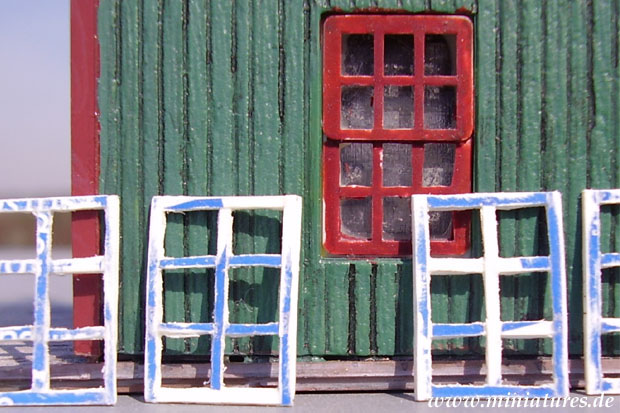
These 1:72 scale windows were made from an Alnatura yoghurt container by gluing narrow strips of the material to a 12 x 15 mm polystyrene sheet to serve as window muntins. Once the laminate has hardened, the areas between the muntins can be painted to represent window panes, or, as shown here, cut out with a scalpel. In the latter case, the frame is backed with clear window film, followed by printed paper curtains. These prototype yoghurt container windows are not as delicate and perfect as the 1:87 scale Kibri Post Office window shown behind them, but once painted and installed, they should look convincing enough.
Since 2013, Alnatura has been selling yoghurt cups made of 0.25 mm polystyrene, packaged in a tear-off, perforated cardboard sleeve. The thinner polystyrene material of the new yoghurt cups is particularly useful for conversion work on 1:87 to 1:72 scale vehicle models.