Italian Paratroopers
Atlantic 1:87 Scale Figure Review
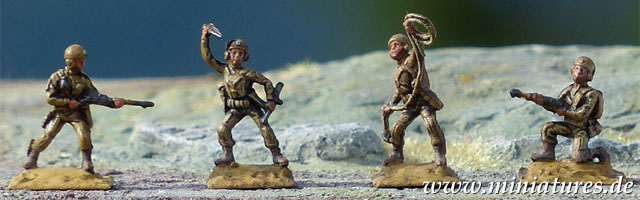
In 1972, Atlantic released a set of 1:87 (H0) scale paratroopers, labeled generically as “Parachutistes, Fliegercorps, Paratroopers, Paracadutisti”. The front of the packaging featured an illustration of U.S. Paratroopers from the Second World War; however, the figures actually represent Italian NATO paratroopers, identifiable by the distinctive quilted padding on the elbows, shoulders, and knees of their uniforms. While the Italian Army of the 1950s and 1960s generally favored NATO-olive uniforms, specialized units – such as the Navy’s COMSUBIN (Comando Subacquei ed Incursori), the “Reggimento San Marco” marines, and the paratroopers of the “Folgore” Brigade – were issued new camouflage uniforms based on the M1929 telo mimetico pattern, which differed only slightly in color from the original version used during the Second World War.
Contents
Figures in 11 Poses – 20 mm equal 173 cm Height
- Italian Paratrooper boarding the Jump Aircraft
- Italian Paratrooper with SMG, landing or falling
- Italian Paratrooper, landed, discarding the Parachute
- Italian Paratrooper with recoilless Anti-Tank Weapon
- Italian Paratrooper with Grapnel
- Italian Paratrooper with SMG and Dagger
- Italian Paratrooper with Rifle, advancing
- Italian Paratrooper with Carbine, kneeling
- Italian Paratrooper with Carbine, jumping over Brush
- Italian Paratrooper with Rifle, prone, firing
Evaluation
Good choice of subject, the Italian NATO paratroopers are unique in this scale. The figures can be clearly identified as Italian paracadutisti by the quilted knee pads on their “pantalone mimetica da lancio” (camouflaged jump trousers).
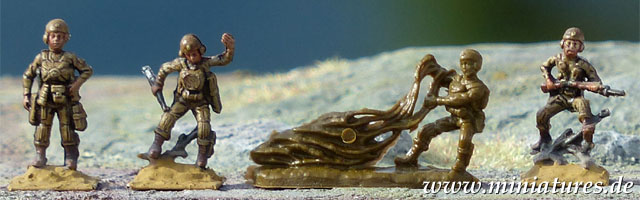
The exaggerated action poses severely limit the versatility of these soldiers. It seems the sculptor lacked a clear vision of the specific situation in which this group of just ten paratroopers is meant to be operating. One man is evidently still on the airfield, waiting for the order to board his transport aircraft, while three of his comrades are already arriving in the landing zone and engaging in combat. The soldier with the grappling hook appears to be clearing booby traps or wire obstacles — or perhaps preparing to breach a building — while the man with the combat knife is already locked in close-quarters combat with the enemy. Unfortunately, the set lacks squad and platoon leaders, radio operators, machine gunners, and other specialists.
The paratrooper preparing to board an aircraft wears, in addition to his personal gear and packed weapon, a harness assembly — comprising both a main and a reserve parachute — which is discarded immediately upon landing. It appears the modeler did not fully grasp this aspect of paratrooper equipment, as several of the soldiers depicted in combat are still wearing reserve parachutes on their chests.
The steel helmet shown is erroneously depicted with ear flaps, which are reminiscent of the leather pilot–s helmet from the 1930s — a type worn by Italian paratroopers during training jumps. Correcting this error would require a great deal of effort.
Uncharacteristically for paratroopers, the four riflemen appear to be carrying the Beretta BM59 Mk I semi-automatic rifle with a full stock — though notably without a detachable box magazine. The correct weapon for paratroopers would be the Beretta BM59 Mk III TP (Truppe Paracadutisti) variant, which features a folding stock, a pistol grip, a shortened barrel, and a muzzle brake/flash suppressor. Furthermore, the submachine gun depicted cannot, by any stretch of the imagination, be identified as either a Beretta MAB 38/49 or a Beretta M12. While the weapon’s length — calculated at 739 mm — is closer to that of the MAB 38/49 (798 mm) than the Beretta M12 (660 mm), the box magazine shown is both too short and positioned incorrectly.
The kneeling rifleman seems to be prepared for every imaginable combat situation; he has cartridge pouches for his carbine and two additional MP 40 cartridge pouches. It's just a shame that he doesn‘t have an MP 40 slung across his back so that he may use the six magazines somehow.
Prominent mould lines must be removed before painting. The figures also feature distinct ejector pin marks on the chest or back, which should be filled in with modelling wax.
The Atlantic H0 scale Paratroopers can only be identified as Italian NATO Paratroopers by their distinctive, quilted knee pads and modern equipment. Those wishing to use these figures for dioramas or wargames will need to supplement them with officers, non-commissioned officers, radio operators, machine gunners, and mortar crew from other figure sets.