US Infantry
ESCI 1:72 Scale Figure Review
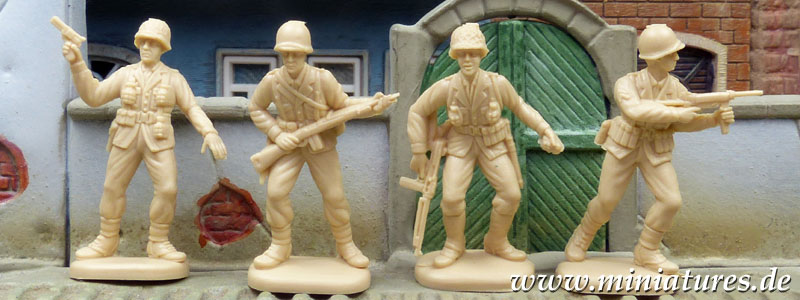
ESCI 1:72 scale U.S. Soldiers wearing a strange hybrid M1941 field jacket with open collar and shoulder straps, combined with two front pockets with horizontal pocket flaps of the M1943 field jacket. The painting instructions call for US Army wool trousers, so this is clearly meant to represent the most typical uniform worn by US Army soldiers in the European Theater of Operations.
Contents
50 Figures in 15 Poses – 24 mm equal 173 cm Height
- Officer with Pistol (2)
- NCO with M1A1 Thompson SMG (5)
- NCO with M3 SMG “Grease Gun” (5)
- NCO/Specialist with M1 Carbine, advancing (3)
- Machine Gunner No. 1 with M1917A1 Browning HMG, kneeling, firing (2)
- Machine Gunner No. 1 with M1919A4 Browning MMG, prone, firing (2)
- Automatic Rifleman with BAR, advancing (5)
- Mortar No. 1, kneeling (3)
- Mortar No. 2 with M1 81 mm Mortar, standing (3)
- Rifleman with M1A1 Bazooka, kneeling, firing (2)
- Engineer with M2 Flamethrower, advancing (3)
- Engineer with Mine Detector, advancing (2)
- Rifleman with M1 Garand Rifle, standing, firing (5)
- Rifleman with M1 Garand Rifle, kneeling, firing (5)
- Rifleman with M1 Garand Rifle, prone (3)
Evaluation
Good choice of subject, wargamers and collectors can never have enough US infantry, even if these figures are wearing a weird hybrid of the M1941 field jacket with two front pockets of the M1943 field jacket.
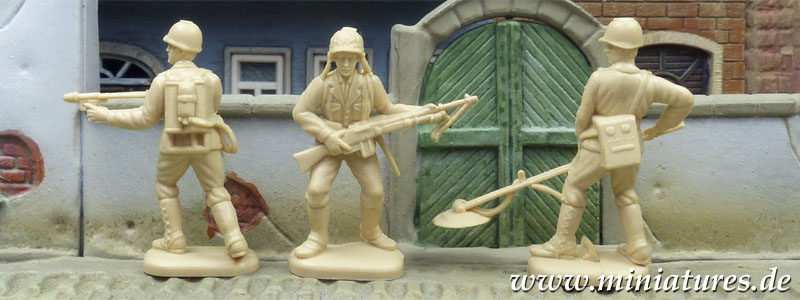
The sculpting is of the same crisp quality we have come to expect from ESCI, but the poses are much less lively than those offered by Airfix US Marines.
Many of the weapons are so out of scale as to be almost unrecognizable. An accurate M1 carbine would be 12.6 mm long in this scale, but ESCI made theirs so much longer that it can be mistaken for a Browning Automatic Rifle. The M1 Garand rifle is 18 mm long, when it should be just 15.4 mm in this scale. The BAR is 19.3 mm long, compared to only 16.7 mm in 1:72 scale. Oversized weapons are much easier to produce, of course, but they imbue these figures with an exaggerated, toy-like quality.
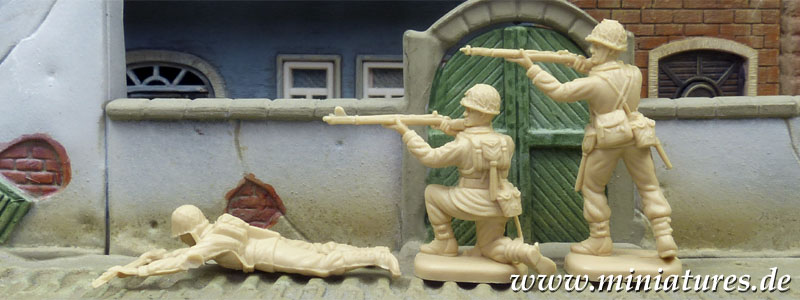
There are only 13 riflemen in this set, just enough to raise one single rifle squad, but they are mostly in standing and kneeling firing poses which look rather out of place beyond the Napoleonic battlefield. Marching, patrolling, and advancing riflemen would have been much more useful to wargamers and diorama builders.
The prone and kneeling rifleman, the two NCOs, and the automatic rifleman appear to be carrying their M1936 musette bags on M1936 suspenders and with the intrenching tool strapped to them, whereas the standing rifleman has his musette bag on a general purpose strap slung across the right shoulder. This is the kind of variety we don‘t need, because it makes the standing rifleman incompatible with the other figures who cannot possibly be serving in the same platoon with him.
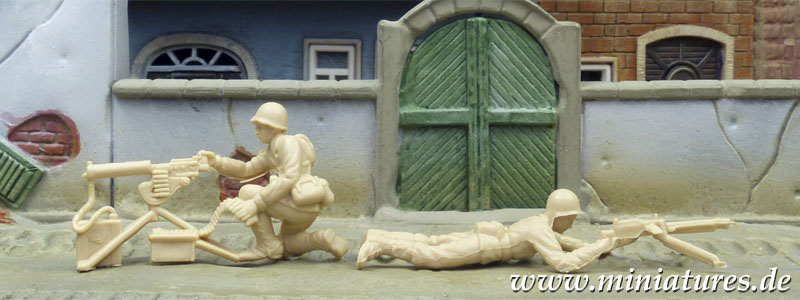
The soldier with the M1 carbine does not look like an officer commanding a rifle platoon, and he could not be the Staff Sergeant, Section Leader of the Mortar Section, or the Corporal, Squad Leader of the Light Machine Gun Squad either, because his cautiously advancing pose is completely incompatible with the prone machine gunner firing the .30 cal. Browning M1919A4 and the standing firing mortar team. He appears to be just another lost soul stumbling around the battlefield. Compare him to the machine gun and mortar teams produced by Airfix which often consist of three nicely compatible figures.
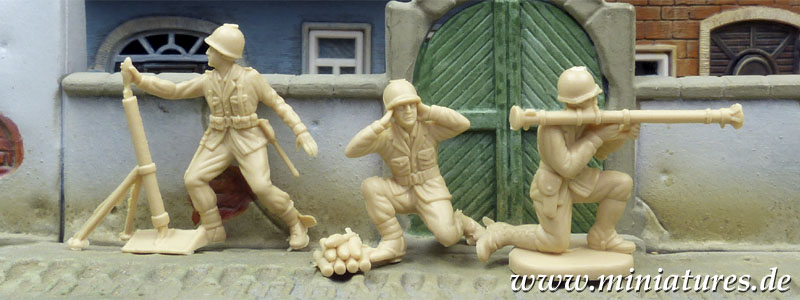
Three of the kneeling and standing poses are cast without bases which is sure to frustrate kids and toy soldier fans who play with unpainted figures. Not only do these soldiers fall over all the time, they also appear shorter than the other soldiers in this set who are mounted on bases.
Some flash, and noticeable mould lines need to be removed prior to painting.
Compatible with Airfix, and Revell.
Historical Employment
- US Infantry in M1941 Field Jacket and Wool Trousers, 1941–1945
Painting Guide
The painting instructions recommend Model Master enamel paints, which tend to accelerate plastic corrosion, and Model Master Acrylic paints which are the safer choice for these figures.
- Model Master Acrylic 4390 »Skin Tone«: Faces, Hands
- Model Master Acrylic 4681 »Gun Metal«: Pistol, SMG, Rifle Barrel
- Model Master Acrylic 4728 »Olive Drab«: Steel Helmet, Intrenching Tool Carrier
- Model Master Acrylic 4708 »Field Green«: Field Jacket
- Model Master Acrylic 4697 »Flat Tan«: Wool Trousers
- Model Master Acrylic 4720 »Sand«: Webbing, Gaiters
- Model Master Acrylic 4674 »Leather«: Boots
- Model Master Acrylic 4673 »Wood«: Rifle Stock
The US M1941 Field Jacket was Olive Drab No 2, a pale olive colour which quickly faded to an almost khaki shade. The recommended Model Master Acrylic 4708 »Field Green« appears to be much too green to match Olive Drab No 2.
ESCI 1:72 scale U.S. Soldiers offer a nice selection of mortars and heavy machine guns for the Heavy Weapons Company of the US Army Infantry Battalion, light machine guns for the Weapons Platoon of the Rifle Company, and automatic rifleman, but very few actual riflemen to fill the ranks of the Rifle Platoons.