Japanese Soldiers, 1938–1945
ESCI 1:72 Scale Miniatures Review
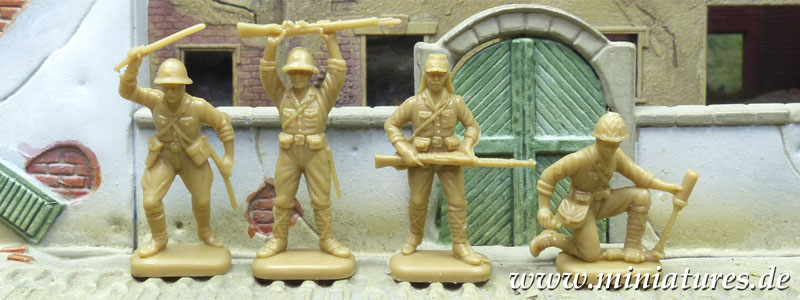
The ESCI 1:72 scale Japanese Infantry offers 15 different poses, providing everything a collector or wargamer needs to field an infantry company. The inclusion of the Type 92 heavy machine gun also allows for the representation of the two machine-gun platoons belonging to a battalion‘s heavy weapons company, though the 70 mm Battalion Gun Type 92, also part of such a company, is notably absent. The soldiers‘ equipment is largely inaccurate or incomplete, and the haphazard way in which it is worn unfortunately contradicts both standard military practice and official regulations.
Contents
50 Figures in 15 Poses – 23 mm equal 166 cm Height
- Japanese Officer with »Shin-Guntō« Army Sword (2)
- Japanese Soldier, shouting »Banzai!« (3)
- Japanese Soldier with Type 89 Mortar (2)
- Japanese MG-Schütze with Nambu Typ 92 s.MG (2)
- Japanese MG-Schütze with Nambu Typ 99 l.MG (3)
- Japanese Soldier, advancing, with Field Cap (5)
- Japanese Soldier, advancing, with Steel Helmet (3)
- Japanese Soldier, standing, firing (5)
- Japanese Soldier, kneeling, firing (5)
- Japanese Soldier, kneeling, with drawn Entrenching Tool (2)
- Japanese Soldier, charging (5)
- Japanese Soldier, charging, bareheaded (3)
- Japanese Soldier, fencing, bareheaded (3)
- Japanese Soldier, throwing Hand Grenade (5)
- Japanese Soldier, prone, throwing Hand Grenade (2)
Evaluation
Excellent choice of subject, the ESCI 1:72 scale Japanese Infantry offers the full complement of officers, numerous riflemen, the 50 mm Type 89 mortar, and Type 99 Nambu light machine guns for an infantry company. The Type 92 heavy machine gun belongs to the battalion‘s heavy weapons company, which can be partly represented. While the ESCI figures are slightly larger — and consequently equipped with longer weapons — than their 1:76 scale Airfix and Matchbox counterparts, this size difference is practically imperceptible in a diorama or wargaming unit.
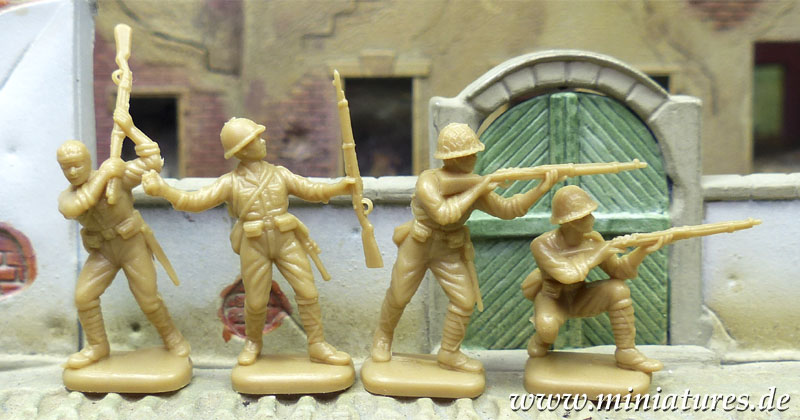
The soldiers are wearing tropical uniforms, consisting of a lightweight cotton shirt (»Bousho Jyu-han«) with patch breast pockets, long trousers (»Bousyo-ko«) with wrap-around puttees (»Kya-han«), a steel helmet, and boots (»Amiage-gutu«). The combat jacket belonging to the tropical uniform was not worn in warm weather; it featured the same cut as the M.98 field jacket (»98 Shiki-Gun-i«), with internal side pockets and breast pockets that had either curved or straight flaps.
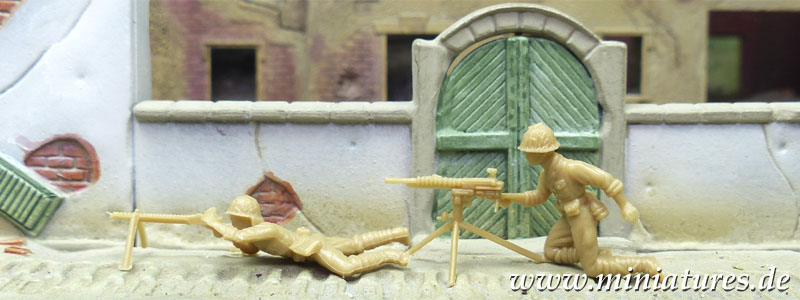
The equipment of these Japanese soldiers is incomplete, and the way it is worn is, in some instances, haphazard. The root of this error is as trivial as it is consequential: the designer and the sculptor evidently failed to grasp that the haversack and the canteen — each on its own strap — are meant to be worn together over the left shoulder. The haversack was positioned against the soldier‘s body, allowing the canteen to rest upon it; this prevents the canteen from swinging unchecked and repeatedly striking the soldier‘s right thigh while he is running. In the case of most riflemen, the canteen hangs to the left of the haversack, attached directly to the equipment belt, leaving no room for the large ammunition pouch intended to hold 60 reserve rounds. Only the officer, the machine gunners, and the soldier equipped with the 50 mm mortar possess this large pouch — an item that is, in fact, entirely superfluous for these specific individuals. Consequently, the officer and the light machine gunner are left without canteens, while the heavy machine gunner lacks a gas mask case.
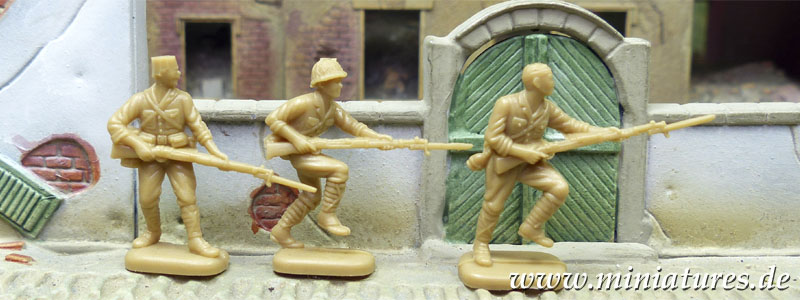
Eight of the eleven riflemen either lack a bayonet entirely, or the bayonet is already fixed to the rifle, leaving only the scabbard missing. Some carry a haversack or canteen — or nothing at all — on their left hip, the very spot where the gas mask pouch should be worn over the bayonet scabbard. Five soldiers are equipped with field packs to which mess tins are attached, yet the folding spade is nowhere to be seen. In their depiction of these Japanese soldiers, the designers and sculptors have once again demonstrated the kind of “creativity” typical of ESCI, virtually ignoring military regulations. It would require a significant amount of effort to correct these numerous errors with modeling wax or “Green Stuff”.
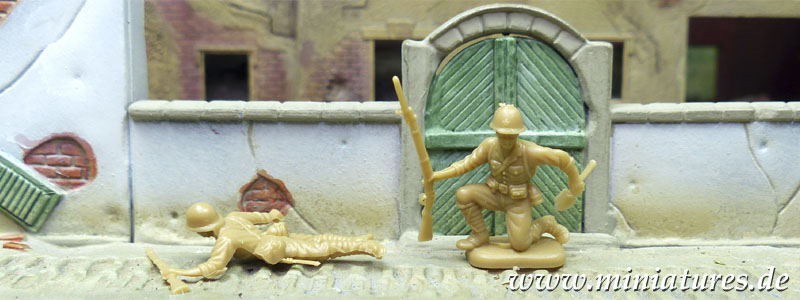
The enlisted men are wearing the peculiar crossed cotton straps over their puttees, which is why these figure require some conversion before they can be painted as Italian infantry of African Askaris.
ESCI 1:72 scale Japanese Infantry are nicely compatible with Japanese Infantry available from Airfix, Atlantic, HäT, Mars, Revell, or Waterloo 1815.