French 114th Infantry Regiment Saxon de La Dauphine, Seven Years’ War, 1757–1760
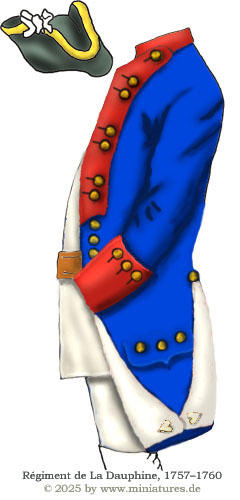
This Saxon foreign regiment was established by royal ordinance of July 1, 1747, from German volunteers recruited by Brigadier August Heinrich, Count of Friesen, and – unsurprisingly – granted to Maria Josepha of Saxony, the Dauphine of France, as the colonel. Maria Josepha, daughter of the Elector of Saxony and King of Poland, was the niece of Marshal Maurice of Saxony, the young Count of Friesen was his nephew.
The Regiment de La Dauphine fought in Flanders in 1748 during the War of the Austrian Succession, as the 139th Infantry Regiment. By the outbreak of the Seven Years‘ War, it had risen in seniority to 115th Infantry Regiment of the French Army, and was one battalion strong. From 1757 onward, the Regiment de La Dauphine served in the French Army of the Rhine, fighting at Hastenbeck, Sandershausen, Lutterberg, and Minden. On January 18, 1760, in the course of the reorganization of the German foreign regiments, it was incorporated into the 101st Régiment Royal-Bavière as the 3rd Battalion.
Mestre de camp commandant
- Maria Josepha of Saxony, Dauphine of France, 1747–1760
Mestre de camp-lieutenant
- Brigadier August Heinrich, Count von Friesen, 1747–1755
- Adam, Count von Löwenhaupt, 1755–1760
Uniform
The État militaire de France, pour l’Année 1758 describes the uniform of infantry regiment de La Dauphine as follows: Habit bleu, parements, revers & collet rouges, le revers est garni de six boutons de deux en deux & un septième à l‘extrémité, trois boutons jaunes sous le revers du côté gauche, pattes ordinaires garnies de trois boutons, culotte & veste blanche avec des boutonnières de la même couleur & d‘un seul côté, les boutonnières des bavaroises sont rouges & celles de l‘habit sont bleues; elles sont toutes de drap, chapeau bordé d‘or.
Blue coat with red cuffs, lapels, and collar; the lapel is trimmed with six buttons arranged in pairs, plus a seventh at the tip, and three yellow buttons beneath the left lapel; standard pocket flaps trimmed with three buttons; white breeches and waistcoat with buttonholes of the same color on one side only; the buttonholes on the cuffs are red and those on the coat are blue—all made of wool cloth; hat edged with gold.
Lucien Mouillard, on the other hand, depicts the uniform of the La Dauphine Infantry Regiment as follows:
- Turquin blue coat with yellow metal buttons
- horizontal coat pockets “ordinaires” with 3 buttons
- red collar
- red lapels with 7 buttons right and left
3 buttons below the left lapel, and 3 buttonholes below the right lapel - red cuffs with 3 buttons
- white turnbacks with white hearts
- white waistcoat with yellow metal buttons
- white breeches
- white gaiters with yellow metal buttons
- black tricorne hat with yellow edging
- Grenadiers wore beards, and sabres, and from 1759 bearskin caps
Campaign History
- Battle of Hastenbeck, 26 July 1757
- French Occupation of Hanover, 1 August 1757
- Combat at Sandershausen (Hesse), 23 July 1758
- Battle of Lutterberg (Hesse), 10 October 1758
- Battle of Minden, 1 August 1759
Lineage
- III. Battalion 101e Regiment Royal-Bavière, 18 January 1760
Bibliography
- Montendre-Longchamps: État militaire de France, pour l’Année 1758 (Paris 1758)
- Mouillard, Lucien: Les régiments sous Louis XV (Paris 1882)
The German foreign regiments of the French army look very dashing in their blue uniforms.