Roman Hastati & Velites
HäT Industrie 1:72 Scale Figure Review
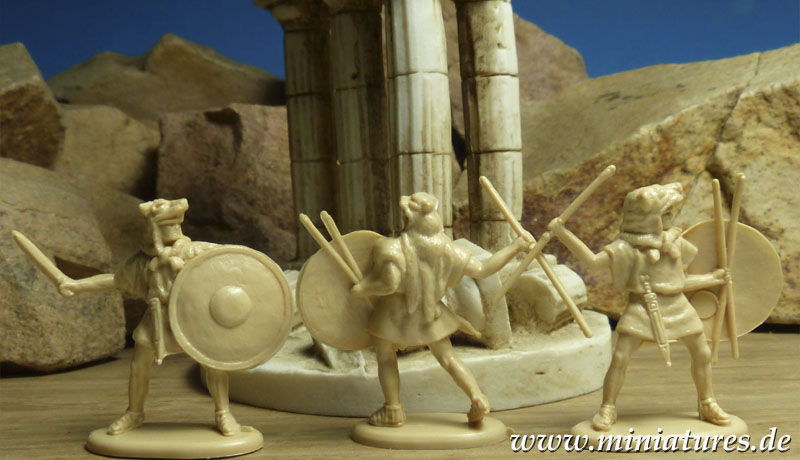
HäT 1:72 scale Republican Roman Hastati & Velites are suitable for the Samnite Wars and Punic Wars. The Hastati in this set are no longer armed with the Hasta thrusting spear, but with two Pila javelins. The Hastati are armed with as Montefortino helmet with unrealistically narrow cheek pieces, and a single greave (Ocrea) on the left leg, which was omitted as a result of the Marian reforms in 107 BC.
Contents
48 Miniatures in 8 Poses – 25 mm equal 180 cm height
- Hastatus with Pila and Parma, marching (8)
- Hastatus with Pila and Parma, advancing (8)
- Hastatus with Pila and Parma, throwing Pilum (8)
- Hastatus with Gladius and Parma, advancing (4)
- Hastatus with Gladius and Parma, slashing (4)
- Veles with hastae velitares and Clipeus, throwing Javelin (4)
- Veles with hastae velitares and Clipeus, throwing Javelin (4)
- Veles with Gladius and Clipeus, fencing (4)
Evaluation
Good choice of subject, the Republican Roman Hastati and Velites are suitable for wargames and dioramas of the Samnite Wars and Punic Wars.
Unfortunately, at 180 cm height, these figures are much too tall for soldiers of ancient Rome. This is probably why HäT re-released the same figures as “25 mm Figures” in their subsequent figure set of Roman Catapults (HäT 8035).
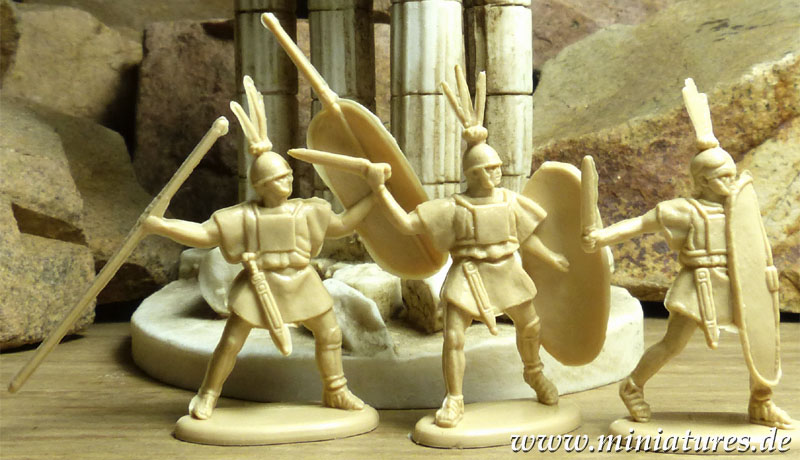
The square pectoral plate (Greek: cardiophylax, chest protection) of the Hastati portrayed here appears to have been replaced early on by a handspan-sized, round breastplate. The Greek historian Polybius (c. 200–120 BC) explicitly mentions a round plate worn in front of the chest in this context. HäT, however, has given the Hastati an additional square armour plate to protect their back.
Three of the five Hastati are depicted in combat with their shield arm wide open. This error may be somewhat corrected by bending the left arm so that the shield is held closer to and protectively in front of the body.
Two of the five Hastati are wearing a Montefortino helmet that appears to be covered with fur or some other soft material, obscuring the helmet‘s characteristic conical shape. Might this be a production error?
In close order, the Roman gladius was primarily used as a thrusting weapon. The fact that the Hastati in the center of the image has switched to slashing seems to suggest a more disordered formation. Wargamers will want to correct this pose by removing the gladius and replacing it with a pilum. The hastati advancing with his gladius drawn is holding his sword away from the enemy. This error may be corrected by bending his sword arm forward.
The shields are all sculpted without a central grip on the inside. It‘s unclear how the Hastati & Velites could have held the shield plus one or more javelins with only one hand. Was the sculptor unaware of the particulars of the grip system, and simply omitted this important detail? The Veles on the right of the upper image has a rather noticeable ejector pin mark on the inside of his shield, and in a difficult to reach place at that.
The tunics of the Hastati and Velites feature oversized sleeves, which make the Hastati, in particular, appear extremely broad-shouldered. Furthermore, the sleeves of two Hastati seem to defy gravity, further reinforcing the negative overall impression.
Officers, non-commissioned officers, and musicians are missing; they were only added in 2001 with the set “Roman Command” (HäT 8051).
Noticeable mould lines need to be removed prior to painting.
Historical Employment
- Republican Roman Velites, 211 to 107 BC
- Republican Roman Hastati (Manipular System), 290 to 107 BCs
For our purposes in wargaming, the Hastati might have been fully represented with just one pose of an Hastatus advancing into battle with some determination. The marching and advancing Hastati come close to this requirement, although they do not wield their shields or pila in a combat-like manner. The three remaining poses might therefore have been used for Hastati officers, non-commissioned officers, and musicians. For dioramas, however, the variety of poses is completely insufficient. Separate figure sets for Hastati and Velites would have been required to provide more variety, possibly even including a small campfire or barracks scene.