Renault FT Light Tank
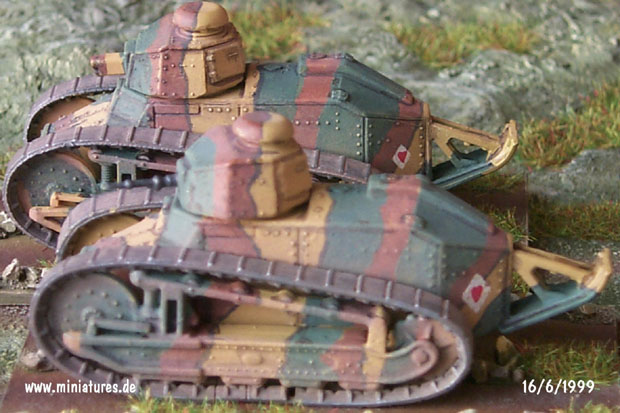
The Renault FT was designed as an infantry tank, and it served in over 3000 engagements between May 1918 and the Armistice in November of the same year. The vehicle was bulletproofed with 22 mm of turret and frontal armour, enabling it to attack enemy machine gun positions with minimal risk to the crew. One weak point was the drive sprocket, it was made of wood and it could be whittled away by enemy fire. Despite its small size, the Renault FT moved at the same slow speed as the much heavier Char Schneider CA1, but 8 km/h was good enough to keep pace with infantry advancing on foot.
Available Models
- Char léger Renault FT (Berliet Turret), 1:30 John Jenkins Designs GWF-07H
- Char léger Renault FT (Berliet Turret), 1:30 John Jenkins Designs GWF-07P
- Char léger Renault FT (Girod Turret), 1:30 John Jenkins Designs GWF-08H
- Char léger Renault FT (Girod Turret), 1:30 John Jenkins Designs GWF-08P
- Char léger Renault FT, 1:35 Meng Models TS-008
- Char léger Renault FT (37 mm Gun), 1:72 HäT 8113
- Char léger Renault FT (Hotchkiss MG), 1:72 HäT 8114
- Char léger Renault FT, 1:72 Flyhawk 3001
- Char léger Renault FT, 1:76 Hinchliffe 20/210
- Char léger Renault FT (Hotchkiss MG), 1:76 Hinchliffe 20/210A
- Char léger Renault FT (37 mm Gun), 1:76 Hinchliffe 20/2108
- Char léger Renault FT (Berliet Turret), 1:76 Matchbox 40176
- Char léger Renault FT, 1:76 Red Star Models RS 93
- Char léger Renault FT (Girod Turret), 1:87 World Tanks Depot 48
- Char léger Renault FT (37 mm & MG), 12 mm Minifigs FV-05
- Char léger Renault FT Commandement, 1:76 Hinchliffe 20/210C
- Char léger Renault FT Bulldozer, 1:76 Hinchliffe 20/210D
- Char léger Renault FT, 15 mm Forged in Battle F-01
- Char léger Renault FT (Girod turret), 15 mm Forged in Battle F-02
- Char léger Renault FT (Hotchkiss MG), 1:285 GHQ Models FR15
- Char léger Renault FT (37 mm Gun), 1:285 GHQ Models FR15
- Char léger Renault FT (Hotchkiss MG), 1:300 Heroics & Ros GWF01
- Char léger Renault FT (37 mm Gun, cast turret), 1:300 Heroics & Ros F11
- Char léger Renault FT (37 mm Gun), 1:300 Heroics & Ros GWF02
- Char léger Renault FT.bis with 75 mm L/18, L/12 (1920–40)
The Renault FT saw much service between the World Wars, it was engaged in the Rif revolt in Morocco, 1925–1927, and it served with the Republican Forces in the Spanish Civil War, 1936–1939. In 1940, many of the now obsolete FT light tanks remained in service, and they accompanied French infantry into battle once again. Following the fall of France, Renault FT light tanks entered service with the Wehrmacht. The vehicles were fitted with radios, and they were employed in the internal security role in occupied France and on the Channel Islands.
Move or Turn
The Renault FT and other tanks with cleattrack steering, or gear-brake-clutch steering could only move or turn, but not both at the same time. Accordingly, simulation gamers should penalize the Renault FT in combat, requiring that the vehicle may either move forward, backwards or turn in place. Pirouette turns, i.e. with one track turning forward and the other track turning backwards, are not possible with this type of steering. By comparison, modern tanks are able to turn as they are moving in one or the other direction. Players quickly appreciate how difficult it is to manœuvre a vehicle like the Renault FT across rough terrain, and to reach a certain destination with accuracy. In 1940, slow-moving Renault FT tanks will find it difficult to evade enemy fire if they are spotted in the open.
Technical and Tactical Lineage
The Renault FT series gave rise to two different lines of new vehicles which fought in World War 2. Technically, the Renault FT is the direct ancestor of the French medium tank series, and the Somua cavalry tank:
Renault D1: 47 mm gun, 30 mm armour, 19 km/h speed
Renault D2: 47 mm gun, 40 mm armour, 23 km/h speed
Somua S35: 47 mm gun, 25-56 mm armour, 41 km/h speed
Somua S40: 47 mm gun, 31-56 mm armour, 45 km/h speed
In 1933, the Renault FT’s role as a light infantry tank – Char Léger d’Accompagnement – was confirmed as a tactical doctrin, and even the cavalry received a similar vehicle type, developed by Hotchkiss. In addition to its cavalry role, the Hotchkiss series was deployed as a fast infantry tank.
Renault R35: 37 mm gun, 32-45 mm armour, 20 km/h speed
Renault R40: 37 mm gun, 40-45 mm armour, 22 km/h speed
Hotchkiss H35: 37 mm gun, 22-45 mm armour, 35 km/h speed
Hotchkiss H39: 37 mm gun, 22-45 mm armour, 36.5 km/h speed
Apparently, Renault had plans to merge the light infantry tank (R40) and medium cavalry tank (S40) idea into a new medium tank design, designated Renault DAC-1, but this project had not been completed when France fell in 1940.
Historical Employment
- French Army Infantry Tank, May 1918 – November 1918
- Italian Army Infantry Tank, 1918
- Finnish Army, 1919–1942. Of the 34 Renault FT tanks serving in Finnland, 15 were armed with the 37 mm gun, and the other 19 vehicles carried machine guns. The original 8 mm Hotchkiss machine guns were replaced by Maxim machine guns in 1937.
- Romanian Army, 1920s–1945.
- French Colonial Forces, Rif Revolt in Morocco, 1925–1927
- Republican Forces, Spanish Civil War, 1936–1939
- French Army, 1940
- German Security Forces, France 1941–1944
Possible Conversions
- Renault FT Command, 1940
- Renault FT Bulldozer, 1940
- Renault FT.bis with 75 mm L.12 tank gun, 1920–1940
- Renault FT with Maxim MG, Finnland 1937–1942