Roman Praetorians, 1st Century BC
Revell 1:72 Scale Figure Review
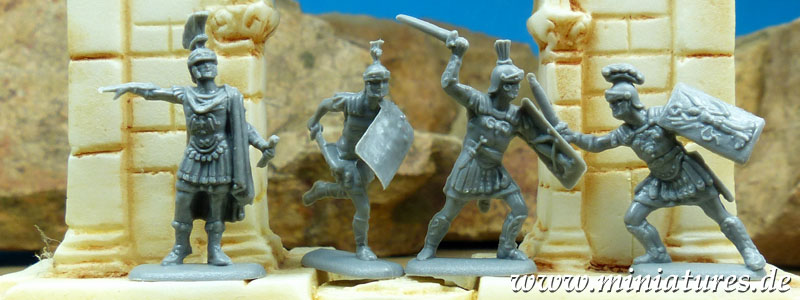
Ten of the 15 Revell 1:72 scale “Praetorians” look like reproductions of antique Elastolin Romans by O. & M. Hausser, which appear to have been inspired by Münchener Bilderbogen Nr. 558 “Zur Geschichte der Kostüme” and similar 18th and 19th century Neoclassical paintings. The figures wear muscle cuirass, scale armour, lorica segmentata, chainmail, or linothorax, various helmets, and so many different shields with unique designs that we are certainly not dealing with a unit of the Roman Imperial Guard.
Contents
50 Miniatures in 15 Poses – 23 mm equal 166 cm height
- Consul with Muscle Cuirass and Paludamentum, gesticulating (2)
- Officer with Muscle Cuirass, Paludamentum, Gladius and Round Shield (3)
- Roman with Pilum and Round Shield, throwing Pilum (3)
- Roman with Gladius and rectangular Shield, running (5)
- Roman with Gladius and rectangular Shield, fighting (5)
- Roman with Gladius and rectangular Shield, attacking (5)
- Roman with Pilum and hexagonal Shield, advancing (3)
- Roman with Pilum and hexagonal Shield, running (5)
- Roman with Pilum and hexagonal Shield, throwing Pilum (5)
- Roman with Gladius and hexagonal Shield, parrying (2)
- Roman with Pilum and Parma, charging (3)
- Roman with Gladius and Parma, defending (3)
- Archer, running (2)
- Archer, shooting (2)
- Slinger, throwing Missile s(2)
Evaluation
Good choice of subject, fans of O. & M. Hausser‘s ancient Elastolin Romans will likely be pleased with this reissue, even if the replicas are now only 23 mm tall instead of 40 mm. If we overlook the fact that some of the figures are equipped with fictitious defensive weapons, there‘s certainly nothing wrong with using these 1:72 scale Romans for wargames and dioramas.
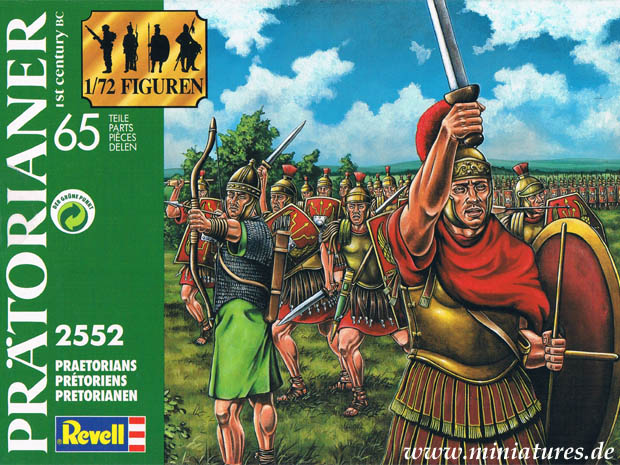
The box art depicts the figures in a much more uniform and orderly fashion than they actually are. Anyone expecting “guards”, advancing resolutely, will be disappointed. The truly appealing and very lifelike poses depict individual combatants in melee. The close order formation we would expect of Roman Imperial Guard formation appears to have dissolved already.
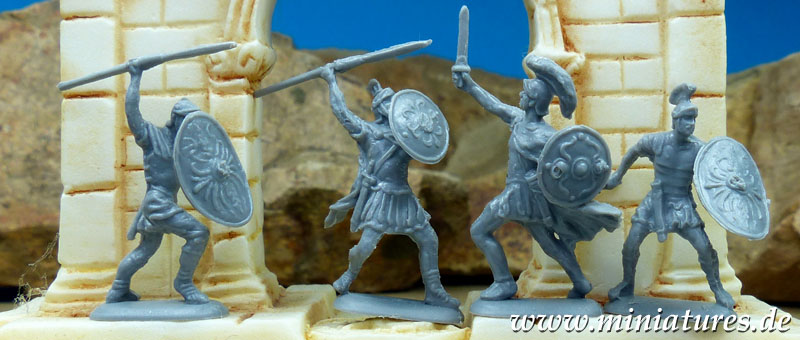
The Pila and gladii look very convincing. The shield designs will certainly look impressive after painting, but they are far too different for the soldiers to be deployed in the same unit. This flaw may be corrected with more uniform shields made of cardboard or polystyrene.
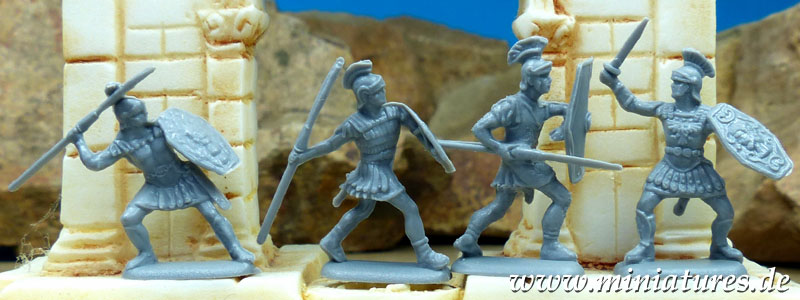
Several figures are wearing unrealistic arm and leg guards that would need to be removed before painting. It may be possible to partially conceal this error simply by painting over the leg guards with flesh tones, without having to resort to a scalpel.
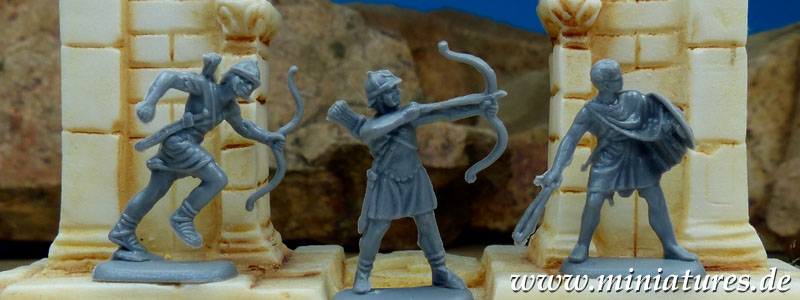
The two archers and the slinger are not Praetorian Guards, but auxiliary troops who can certainly be deployed in combined units with similar figures from other manufacturers.
Noticeable mould lines need to be removed prior to painting.
Historical Employment
- Eastern Archers
- Auxiliary Slinger
Possible Conversions
- Roman Legionaries with uniform Shields, 1st Century BC
Revell 1:72 scale “Praetorians” are not guard troops, but reproductions of old Elastolin Romans by O. & M. Hausser, whose sometimes inaccurate equipment may have come from a Neoclassical painting. Those who aren‘t bothered by this will find a variety of beautiful, lifelike figures for fantasy wargames and dioramas.