Persian Infantry, 5th to 4th Century BC
Zvezda 1:72 Scale Figure Review
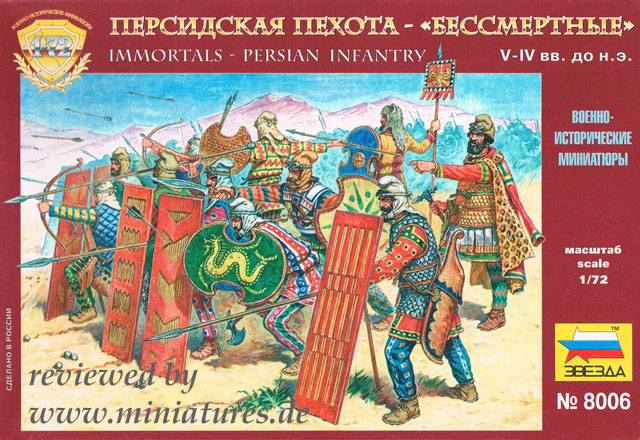
Zvezda 1:72 scale Ancient Persian Infantry includes heavy, medium, light/medium, and light Persian infantry, all of which are well-suited for wargames and dioramas. While the term “Immortals” on the box cover refers to the elite royal guard of the Persian Empire, the figures are equally appropriate for regular, non-guard units.
Contents
45 Figures in 15 Poses – 24 mm equal 173 cm Height
- Persian Officer with Sagaris and Acinaces, signaling (1)
- Persian Standard-Bearer with Violin Shield (1)
- Takabara with Battle Axe and Taka, charging (2)
- Takabara with Xiphos and Taka, attacking (3)
- Takabara with Xiphos and Violin Shield, defending (3)
- Takabara with Makhaira and Violin Shield, kneeling (2)
- Sparabara with raised Spear and Spara, advancing (3)
- Sparabara with raised Spear and Spara, fencing (3)
- Sparabara with Spear and Spara, standing (4)
- Sparabara with Spear and Spara, kneeling (4)
- Archer with Taka, standing, shooting (4)
- Archer, kneeling, shooting (4)
- Archer, reloading (2)
- Light Infantryman with Javelins and Violin Shield, throwing (3)
- Light Infantryman with Javelins and Taka, running (3)
Evaluation
Excellent choice of subject; the Persian Infantry offer many useful poses for wargames and dioramas. The soldiers wear short tunics (sarapis) cinched by a waistbelt from which the Persian short sword (acinaces) is suspended on the right side, long trousers (anaxyrides), soft, ankle-high leather boots (persikai), and the Persian tiara (kyrbasia), a type of Phrygian cap featuring extended side flaps (ear flaps) and a neck guard. With the exception of the javelinman carrying a violin-shaped shield, the soldiers are armoured in a variety of ways: they wear quilted fabric or leather armour, linothorax and, in the case of a sparabara, even scale armour.
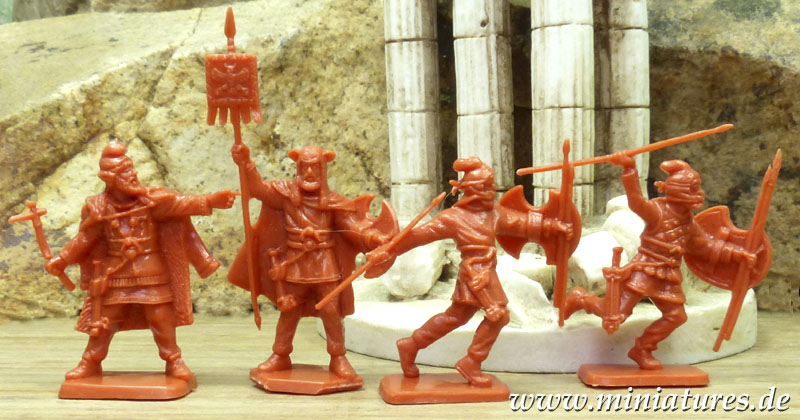
The plastic is quite hard, which means that delicate parts, such as the sagaris (axe) carried by the Persian officer, can easily break off during gameplay. It is advisable to mount the Persian infantry on wargaming bases, where the figures are better protected against damage.
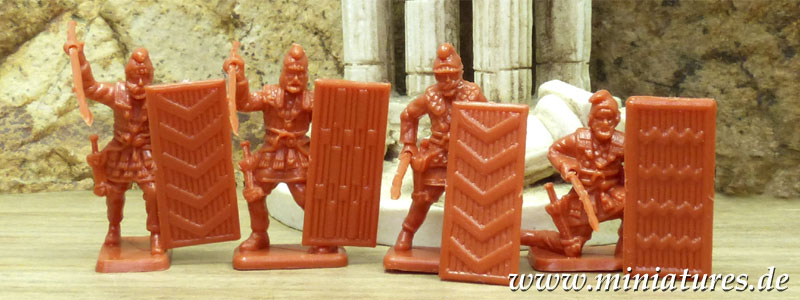
The four Sparabara fit onto a 60 × 20 mm base designed for spearmen (SP) in close order, as per the De Bellis Antiquitatis (DBA) game system.
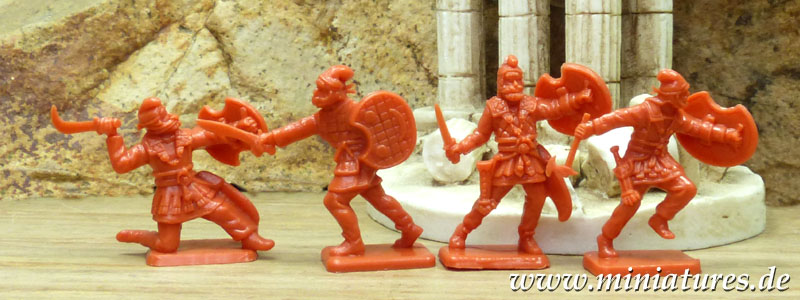
In the Classical Hack game system, the Takabara can be fielded either as heavy infantry (4 × HI) or as light/medium infantry (3 × LMI). A practical approach is to mount the figures onto ferromagnetic bases and then place four or three Takabara together on a single stand.
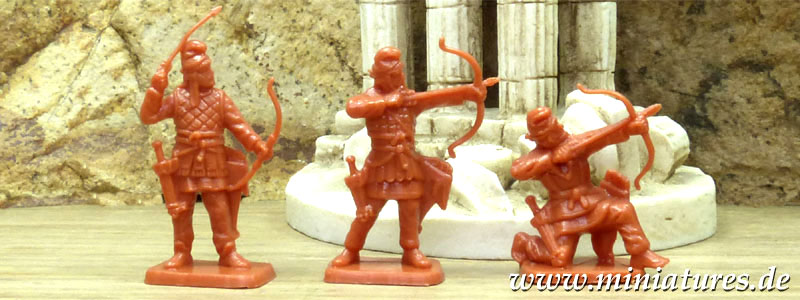
The two standing archers can be deployed in close order (4 × Bw) behind the first line of sparabara, whereas the kneeling archer is better suited for units of psiloi (2 × Ps).
Historical Employment
- Ancient Persian Infantry, 5th to 4th Century BC
Bibliography
- Funcken: le costume et les armes des soldats de tous les temps, Vol. 1, pp. 24-29
- Head, Duncan: The Achaemenid Persian Army (Montvert, Stockport, 1992)
- Osten, Hans Henning v. d.: Die Perser (Essen 1956)
- Sekunda, Nicholas: The Persian Army, 560–330 BC (London 1992]
Zvezda Persian Infantry offers excellent and highly useful wargaming poses; these can be supplemented with foreign mercenaries (cardaces), using Greek Infantry, as well as Asian cavalry, and Scythian chariots to recruit a complete Persian army.