Russian Infantry of Peter the Great, 1698–1725
Zvezda 1:72 Scale Figure Review
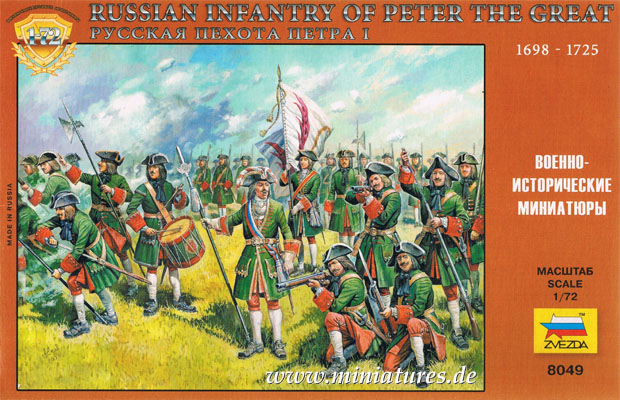
The Zvezda 1:72 scale Russian Infantry of Peter the Great is an excellent choice for wargamers wanting to recruit realistic-looking battalions and regiments. The set includes a sensible mix of marching, advancing, firing, and standing soldiers with no exaggerated poses that would disrupt the overall impression of a cohesive formation.
Contents
43 Figures in 12 Poses – 25 mm equal 180 cm Height
- Russian Officer with Spontoon (1)
- Russian Standard-Bearer with Flag (1)
- Russian NCO with Partisan (1)
- Russian Drummer (1)
- Russian Grenadier with Flintlock Musket and Socket Bayonet, receiving (3)
- Russian Pikeman, receiving (3)
- Russian Fusilier, biting cartridge (3)
- Russian Fusilier, marching (6)
- Russian Fusilier, advancing (6)
- Russian Fusilier, standing, firing (6)
- Russian Fusilier, kneeling, firing (6)
- Russian Fusilier with Musket and Plug Bayonet, kneeling, receiving Cavalry (6)
Evaluation
Good choice of subject; these Russian infantrymen are very suitable as soldiers of many other nations of the early 18th century. They wear the older Russian uniform coat with curved pocket flaps, which was replaced by a new model with straight pocket flaps from 1720 onwards. The figures are beautifully sculpted; they could have come from a contemporary battle painting. Once painted, these Russian infantrymen look excellent, and we can‘t wait to see what other 18th century armies Zvezda will release.
Fine mould lines and some flash must be removed before painting. For the standing and kneeling riflemen, for instance, it is advisable to carefully trim away the excess material between the rifle and the left arm using a scalpel. This task is not entirely straightforward, but the effort is well worth it.
The kneeling fusilier with a plug bayonet is appropriate for the period leading up to the Poltava campaign, as the existing plug bayonets were gradually replaced by socket bayonets between 1701 and 1709.
In 1700, an infantry battalion consisted of five companies, each with four officers and 112 soldiers, including 18 pikemen. The battalion‘s 90 pikemen were grouped in the center of the line, while the fusiliers were positioned on the flanks. Following the Poltava campaign, the Russian infantry adopted the tactically superior formation used by the Swedes. Although pikes were no longer employed in combat against Western-style armies, they remained part of the regiment‘s inventory. By 1720, each infantry regiment was equipped with 150 pikes and 3,072 “swine feathers” (pointed stakes), which were carried in the regimental baggage train during campaigns against the Turks and other mounted peoples. Three pikemen per box are sufficient to represent a Russian battalion as it would have appeared up to 1709. Wargamers typically place the regimental command staff in the center of a unit, and this is where the three pikemen can also be deployed. Alternatively, those who have no use for the pikemen can easily convert them into standard-bearers.
Grenadiers served in their own distinct units; it would have been better for Zvezda to provide another fusilier instead, and to include the grenadiers in a separate release dedicated to the infantry of Peter the Great. Converting fusiliers into grenadiers is difficult, as grenadiers carried a cartridge box on their waist belt and a grenade pouch on a shoulder belt (bandolier).
Russian infantry flags of the 1700–1712 pattern were approximately 200 cm wide and 160 cm high; however, the standard-bearer provided here carries a version into battle that measures only 17 × 14 mm. In this case, it is advisable to remove the plastic flag from the pole and replace it with a more realistic-looking paper flag.
Historical Employment
- Russian Infantry of Peter the Great, 1698–1725
The Zvezda 1:72 scale Russian Infantry of Peter the Great is a must-have for wargamers and diorama builders. The figures may be painted to represent early 18th century infantry of many other European nations.