Royal Horse Artillery, 1799–1815
Airfix 1:76 Scale Figure Review
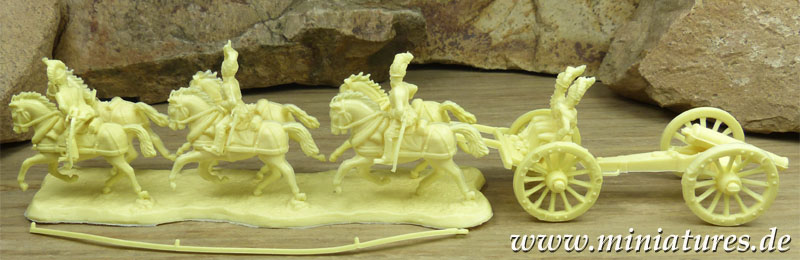
Airfix 1:76 scale Waterloo British Artillery, actually British Royal Horse Artillery (RHA), was uniformed like British light dragoons, namely with the “Tarleton” helmet introduced in 1793 and the braided dolman introduced around 1799.
Contents
14 Figures in 13 Poses – 23.5 mm equal 179 cm Height
- Officer, Royal Horse Artillery (RHA), mounted (1)
- Officer‘s Horse, Royal Horse Artillery (1)
- Officer, Royal Horse Artillery (RHA), with Telescope, standing (1)
- No. 1 Senior Gunner/Aimer missing, can be converted from No. 3
- No. 2 Spongeman with Sponge and Rammer, standing (1)
- No. 2 Spongeman with Sponge and Rammer, ramming Charge (1)
- No. 3 Ventsman with Trailspike, laying the Gun (1)
- No. 4 Loader with Round Shot (1)
- No. 5 Firer with Linstock, firing Gun (1)
- No. 5 Firer at the Carriage Wheel, laying the Gun (1)
- Gunner (RHA) with Water Buckets (1)
- Gunners No. 2 and No. 3, seated on Limber (1+1)
- Royal Horse Artillery Driver for Near Side Lead and Center Horse (2)
- Royal Horse Artillery Driver for Near Side Wheel Horse (1)
- Near Side Horse (3)
- Off Side Lead and Center Horse (2)
- Off Side Wheel Horse (1)
- Limber (1)
- Trace (1)
- 9-pounder Gun Tube, 23.6 mm long (2)
- Block Trail Carriage System Desaguliers (2)
- Wheel with twelve Spokes – 19 mm ⌀ equal 57″ (6)
- Water Bucket (1)
- Cask of Gun Powder (1)
Evaluation
Excellent choice of subject, the iconic Royal Horse Artillery served throughout the Napoleonic Wars and earned particular fame at the Battle of Waterloo, where G Troop, Royal Horse Artillery (Cavalié Mercer‘s Troop) held its ground against repeated French heavy cavalry charges, firing canister to devastating effect, despite orders to abandon the guns and seek refuge in nearby squares formed by Brunswick infantry, whom Mercer thought to be “badly shaken”. There were eight troops of Royal Horse Artillery at Waterloo, compared to only five companies of foot artillery, so Airfix made the right decision here.
For decades, these Airfix figures were the only source of the attractive Tarleton helmet, which was also worn by light dragoons, British foreign troops, and light infantry.
The dismounted gunners are best deployed in the act of ramming the charge. Two of the five gunners are involved in this activity: No. 2 rams the charge or cannonball with his sponge/rammer, while No. 3 holds the touchhole closed with a leather thumbstall. The three remaining crew members are in their ready positions at the left axle (No. 4), to the left of the elevation mechanism (No. 5), and behind the trail (No. 1). The ventsman (No. 3) is missing, but he can be converted from the firer (No. 5) by removing the linstock.
Alternative actions involve: laying the Gun (No. 3 and No. 5), or firing the cannon (No. 5). Gunners not immediately engaged in any of these actions would be standing at attention.
The gunner responsible for aiming (No. 1) is missing, which is why Nos. 3 and 5 are handling the gun completely haphazardly. However, a second gunner (No. 3) might be modified so that he crouches over the barrel, aiming at the target, and giving instructions with his slightly bent left arm.
When the gun is fired, only No. 5 takes action with the linstock, while the other four gun numbers stand at attention around the gun. Unfortunately, Airfix failed to provide a gunner at attention even though this pose would have been particularly useful even in duplicate.
Gunner No. 4 is supposed to stand at attention by the left wheel and with a 3-, 6-, or 9-pounder cannonball in his right hand until it is his turn. However, the way this Airfix gunner handles the cannonball looks highly un-soldierly.
When not sponging the barrel or ramming a charge, gunner No. 2 would stand at attention by the right wheel, with the sponge/rammer at the shoulder. Balancing the sponge/rammer in front of his body, as the Airfix gunner does, is pointless and wastes energy unnecessarily.
The officer with telescope and gunner No. 4 with cannon ball are equipped with modern anti-gravity scabbards, which stand upright next to both figures instead of being suspended on a crossbelt.
There is only one trace connecting the three teams of horses to the limber, when a realistic artillery harness in this scale would require four at least. It is fiddly enough to put this single trace in place, but then how to scratchbuild the three missing traces? A better alternative may be to paint the horse teams first, and then glue sewing thread in place, using wood glue or clear acrylic medium.
The sabre-armed drivers are men directly attached to batteries (troops) of the Royal Horse Artillery. In the Corps of Royal Artillery Drivers, responsible for limbers and vehicles of the foot artillery, only officers and non-commissioned officers were thus armed.
At 23.6 mm in length, the gun barrel matches the Blomefield 9-pounder “Brass” field gun (24 mm) of the Royal Horse Artillery, but not the Armstrong light 6-pounder “Bronze” field gun (18 mm). A corresponding conversion might be involve using the slightly shorter gun barrel from Revell‘s 02577 British Foot Artillery kit or even shorter turned brass gun barrels designed for ship models. However, all of these gun barrels lack the handles (dolphins), which would have to be scratchbuilt from wire.
The Royal Horse Artillery, newly established in 1793, used standardized 60-inch diameter wheels, which artillery general Thomas Desaguliers had introduced in 1775 along with the block-trail gun carriage he had developed. Airfix wheels, on the other hand, are somewhat smaller, with a diameter of only 57 inches (19 mm).
Historical Employment
- Royal Horse Artillery, 1799–1815
- Long 6-pdr. “Bronze” Field Gun on Block-Trail Carriage, 1788–1815
- Light 6-pdr. “Bronze” Field Gun on Block-Trail Carriage, 1777–1815
- Light 6-pdr. “Bronze” Field Gun on Double Bracket Carriage, 1793–1812
- 9-pounder “Brass” Field Gun on Block-Trail Carriage, 1808–1815
- King‘s German Legion Horse Artillery, 1808–1815
- Horse Artillery of Rohan Hussards, 1795
Possible Conversions
- Corps of Royal Artillery Drivers, 1793–1822.
This conversion involves removing the drivers‘ sabres; the limber may then be used for the foot artillery. - Confederate Artillery.
This conversion involves replacing the Tarleton helmet by a kepi or hat, and removing any lace from the figures‘ chest.
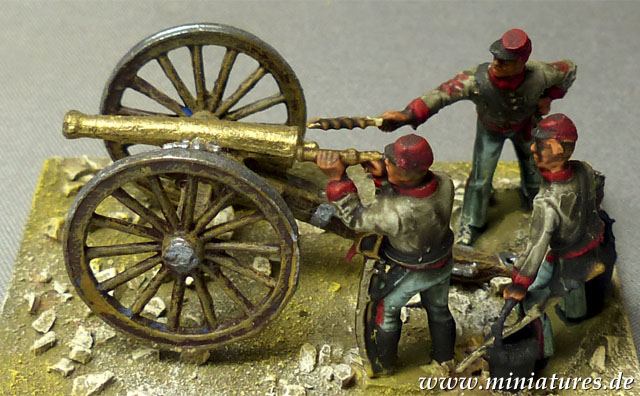
Converted Airfix 1:76 scale Royal Horse Artillery figures work a 12-pounder Napoleon M1857 (Accurate 7204) of the Confederate Army. The figures have been speed painted by dipping them in muted polyurethane varnish.
To this day, Airfix 1:76 scale Royal Horse Artillery offers unsurpassed quality, variety of figure poses, guns, and limbers with complete horse teams in this scale.