Greek Infantry
Atlantic 1:72 Scale Figure Review
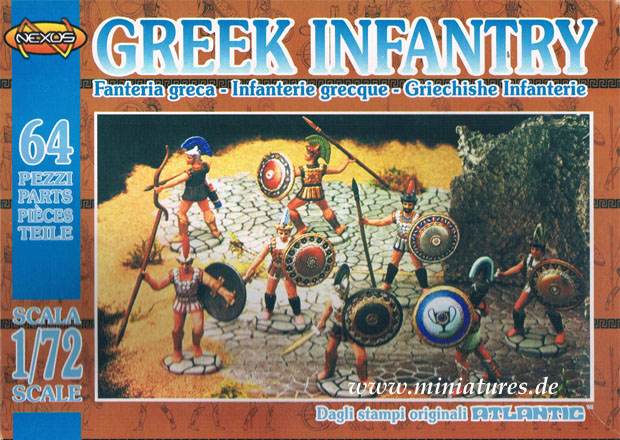
Atlantic 1:72 Greek Infantry offers hoplites in bell cuirass or linothorax, greaves, Attic or Corinthian helmets with horsehair crest, large round shields (aspis), swords, and spears. These highly detailed figures are very easy to paint.
Contents
64 Figures in 8 Poses – 25 mm equal 180 cm Height
- Hoplite with Bell Cuirass, Corinthian Helmet, Xiphos und Aspis, advancing (8)
- Hoplite with Bell Cuirass, Corinthian Helmet, Xiphos und Aspis, standing (8)
- Hoplite with Linothorax, Attic Helmet, Xiphos and Aspis, standing (8)
- Hoplite with Linothorax, Attic Helmet, Xiphos and Aspis, advancing (8)
- Hoplite with Linothorax, Attic Helmet, Spear and Aspis, throwing (8)
- Hoplite with Linothorax, Attic Helmet, Spear and Aspis, advancing (8)
- Hoplite with Linothorax, Attic Helmet, Spear and Aspis, standing (8)
- Archer with Linothorax, Greaves, and Attic Helmet, shooting (8)
Evaluation
Good choice of subject, Atlantic 1:72 scale Greek Infantry are hoplites of the 5th and 4th centuries BC. They were the key troops of the Archaic and Classical periods until they were bested by the hypaspists of the Macedonian phalanx. Similarly equipped infantry existed among the Etruscans and Samnites in Italy. However, these figures are not suitable as possible adversaries of Atlantic‘s Trojan army.
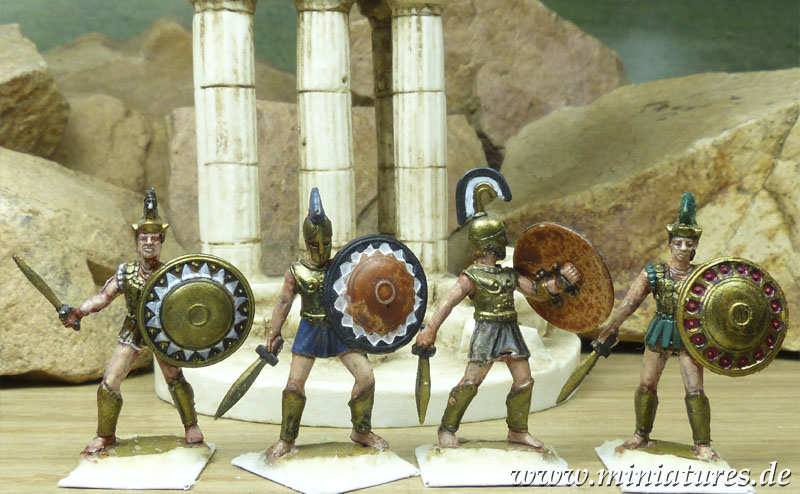
Six of the eight hoplites are wearing an Attic helmet with movable cheek pieces, which was far less common in Greece than the Corinthian, Phrygian, or Thracian helmets. Unfortunately, even the fighting hoplites have left the cheek pieces open, presumably to better show their faces. The sculptor may have been inspired by corresponding illustrations on page 41 of Liliane and Fred Funcken‘s 1966 book on uniforms, le costume et les armes des soldats de tous les temps, to depict the hoplites in this casual look. The mistake may be corrected by a head swap, using heads from Zvezda Ancient Greek Infantry.
Heads with the Attic helmet are well-suited for Etruscan infantry. The interior image, “Achilles Joining Patroclus”, of an Etruscan drinking vessel (kylix) from Sosias, ca. 500 BC, is also relevant. The painting, dating from 500 BC, depicts the Greek hero Achilles in precisely this armour, with the cheek pieces of his helmet open (Antiquities Collection Berlin). Achilles is not engaged in battle at this time, so he could very well have had the cheek pieces open while bandaging his friend and comrade-in-arms, assuming he was indeed wearing an Attic helmet.
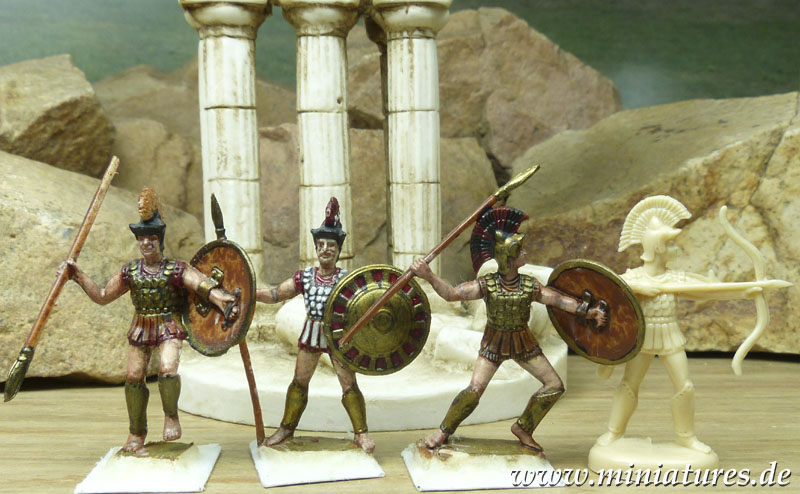
The 2 to 2.5 m long hoplite spear was a thrusting weapon used in melee; it was not normally thrown. If the figure throwing his spear is actually meant to represent a peltast, he would not wear heavy armour, and his javelin would have to be significantly shorter. If the spear was broken or otherwise rendered unusable in melee, the hoplite would fight on with his sword. Accordingly, the four hoplites with drawn xiphos must be in close proximity to their enemy. One of them actually appears to be parrying a blow with his shield, but the other three seem rather bored and indifferent.
The advancing spear-armed hoplite holds his shield away from his body, like a falling soldier might. In combat, he would certainly hold the large round shield close to and in front of his body for maximum protection. This error can be corrected with some effort by removing the left arm along with the shield and attaching it in front of the body. The linen armour must then be carefully reconstructed.
The double-grip system in the shields‘ interior is depicted incorrectly. The hoplite slid his left forearm through a central armband (porpax) made of bronze or leather, and grasped the leather or rope handgrip (antilabe) near the outer rim. Atlantic sculpted several different grip systems, one of which looks incredibly painful to use. This mistake does not necessarily need to be corrected, as it is only visible from behind on most figures. The shields exhibit an unusual, ring-shaped boss, which can be removed with fine sandpaper.
Archers were light troops; they did not wear expensive armour, the weight of which would have been a hindrance in skirmish combat. Accordingly, the hoplite with the reflex bow belongs to the realm of fantasy. Anyone who absolutely must correct this figure might carefully transform the expensive scale armour into a slave‘s exomis, using a wax carving instrument. In addition, the greaves must be removed, and the quiver should be worn on the back, behind the right shoulder. In Wolfgang Petersen‘s film “Troy”, Myrmidon archers shoot at Trojan infantry from a shield wall in front of the Temple of Apollo. From the perspective of this film, there‘s certainly nothing wrong with using Atlantic‘s armoured archers as Myrmidons.
Mould lines on weapons, helmets, and bare skin must be removed prior to painting, ideally using a wax carving instrument.
These Atlantic miniatures are the same height as Brad Pitt in the film role of Achilles, but they are much too tall for the ancient period. Ajax the Great is played in the same film by the 203 cm tall Tyler Mane, who would be just over 28 mm tall in 1:72 scale.
Compatible with ESCI, Italeri, and Zvezda.
Historical Employment
- Fantasy Warriors
- Hyperborean Warriors
- Myrmidons
- Greek Hoplites, 5th to 4th Century B.C.
- Etruscans, 5th to 4th Century B.C.
- Samnites, 5th to 4th Century B.C.
Atlantic 1:72 scale Greek Infantry are very well suited for wargames and role-playing games based on Greek mythology. Equipped with Corinthian helmets, these figures are quite reminiscent of the Myrmidons under Achilles in Wolfgang Petersen‘s film “Troy”.