Union Infantry, 1861–1865
ESCI 1:72 Scale Figure Review
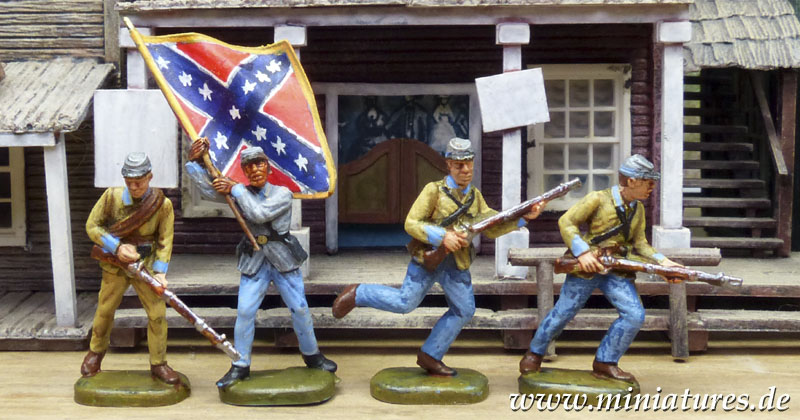
The ESCI 1:72 scale Union Infantry offers a variety of interesting poses that can be painted as either Union or Confederate troops. The standard-bearer shown here is a conversion of the Union soldier in melee, who has had his flintlock musket removed and replaced with a flagpole made of 0.6 mm piano wire. The Confederate battle flag of Bragg‘s 2nd Corps of the Army of Tennessee was hand-painted on paper.
Contents
50 Figures with 15 Poses – 24 mm equal 173 cm Height
- Officer in Frock Coat, with Sabre, signaling (3)
- Color-bearer in Sack Coat, charging (1)
- Drummer in Sack Coat, advancing (1)
- Union Soldier with levelled Musket, advancing (6)
- Union Soldier in Sack Coat, Ambler, charging (6)
- Union Soldier in Sack Coat, standing, firing (6)
- Union Soldier in Sack Coat, kneeling, firing (6)
- Union Soldier in Sack Coat, prone, firing (6)
- Union Soldier in Frock Coat and Hat, ramming the charge (3)
- Union Soldier in Sack Coat, priming the pan (3)
- Union Soldier in Sack Coat, in melee (3)
- Union Soldier in Sack Coat, low crawl (3)
- Union Soldier in Sack Coat and Knapsack, evacuating Casualty (1)
- Union Soldier in Sack Coat, evacuating Casualty (1)
- Union Soldier in Sack Coat, Casualty (1)
Evaluation
Excellent choice of subject. wargamers, collectors, and diorama builders can never have enough Union Infantry to increase the number of available poses.
Useful historic poses. Most of the figures are advancing, firing in line, or loading their muskets. These Union soldiers are well-suited for historical miniature wargames, even if they appear a bit too relaxed for an actual battle.
Satisfactory detail. Kepis, buttons, bandoliers, ammunition pouches, water bottles, metal parts, and weapons are easy to recognize and paint.
The front of the packaging depicts Union soldiers armed with the Springfield Model 1861 rifled musket; however, the figures themselves are equipped with obsolete flintlock muskets, making them better suited as Confederates. The figures also carry a small percussion cap pouch on their belts — placed on either the left or right side, at the whim of the sculptor — even though their flintlock muskets did not use percussion caps at all.
It is highly unusual that none of these Union soldiers are equipped with a bayonet, even though the packaging depicts at least one soldier charging with a fixed bayonet. This oversight can be corrected — albeit with some effort — by soldering bayonets onto the muskets. The missing bayonet scabbards can be fashioned from L-shaped pieces of staples, with the short end inserted into the figure‘s waist belt.
With one exception, these Union soldiers have long since discarded their cumbersome knapsacks, yet only two men carry their belongings in the characteristic blanket roll slung over their right shoulder. The two blanket rolls themselves are far too thin to appear realistic.
The shell of the small drum is far too shallow; it would likely need to be three times as high to accurately represent a 19th-century military drum.
The color-bearer is carrying a Union flag that is much too small — featuring only 20 stars and lacking a finial. A better choice would be a regimental flag made of paper, measuring 25.4 × 27.5 mm (70 × 78 inches) and bearing 34 stars, mounted on a 38 mm long pole made of 0.6 mm piano wire.
The officer carries his revolver in its holster, but mistakenly with the butt facing toward the rear. The small pistol ammunition pouch was worn on the right front of the waistbelt, in front of the holster, not on the left side, above the sabre.
The soldiers carrying a canteen lack a haversack. It appears the sculptor failed to appreciate that the haversack and the canteen were carried on separate straps slung over the right shoulder — with the haversack positioned underneath, so that the canteen rests upon it, preventing it from constantly striking the left hip unchecked while the soldier is running.
Good casting quality, with minimal mould lines. Painting is straightforward, as the details remain clearly visible even after the figures have been primed.
Historical Employment
- Union Infantry, 1861–1865
- Confederate Infantry, 1861–1865
Possible Conversions
- Austrian Infantry, 1859
- Danish Infantry, 1864
The ESCI 1:72 scale Union Infantry is well-proportioned and detailed; once painted, they look quite realistic — even though their equipment is incomplete and, in a manner typical of ESCI, appears to have been sculpted onto these figures rather haphazardly.