French Hussar Regiment Royal-Nassau, 1756–1776
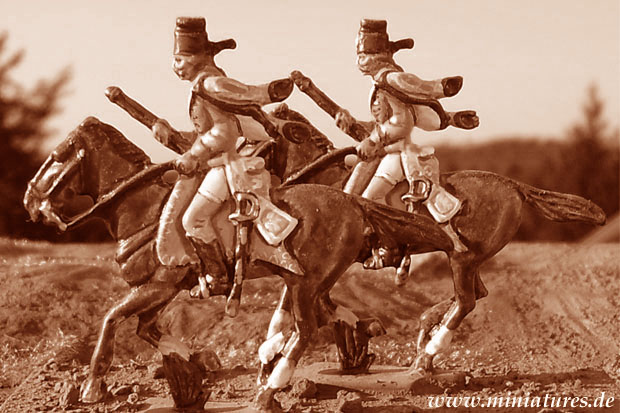
By a decree dated 18 November 1756, the regiment was organized with a strength of 300 men, divided into two squadrons, each comprising two companies of 75 men, excluding officers. Initially known as the Volontaires de Nassau-Saarbrück, the free regiment was renamed Volontaires Royaux de Nassau on 7 April 1758.
Incorporated into the regular French cavalry by a decree dated 14 June 1758, and renamed the Régiment Royal-Nassau de la Cavalerie, the unit was organized with a strength of 600 men, as previously stipulated in specific orders issued on 20 March and 7 April of that year, comprising four squadrons of 150 men each. The first squadron was formed from the mestre de camp lieutenant’s company, consisting of a capitaine en second, two lieutenants en premier, two lieutenants en second, two cornets, four maréchaux des logis (cavalry sergeants), two quartermasters (fourriers), twelve brigadiers (cavalry corporals), 134 troopers, one trumpeter, and one kettledrummer.
The other three squadrons are likewise 150 men strong, though they are composed of two companies, each with a captain, a first lieutenant, a second lieutenant, a cornet, two maréchaux des logis, a quartermaster, six brigadiers, 67 troopers, and a trumpeter.
Staff
The mestre de camp-lieutenant, capitaine of the first company, lieutenant-colonel without a company, major, aide-major, aumônier (military chaplain), surgeon, and provost.
- Mestre de Camp Lieutenant, M. le Prince de Nassau-Saarbruck, Lieutenant-Général
- Lieutenant-Colonel, M. de Wurmser
- Major, M. d’Orbs
- Aide-Major, M. de Werneck, Capitaine
Uniform
Mirliton of black felt, trimmed with white-and-orange goat-hair braid, featuring a fleur-de-lis at the front and a white aigrette on the left with a white ribbon cockade beneath it; black collar; pelisse of red cloth, lined with white sheepskin and trimmed with black lambskin; royal blue dolman; on the chest of both garments, five rows of white buttons and white goat-hair cords arranged in the Hungarian style (à la Hongroise); collar and pointed cuffs of the dolman in light ochre cloth (ventre de biche); sash with loops of red wool and white-and-orange goat hair; ankle-length deerskin breeches, worn under Schalavary of blue fabric, decorated with three rows of cord encircling the trousers; sabretache of red cloth, featuring a crowned lion in the center and trimmed with white-and-orange braid; sabre slings of Russia leather (yuft); Fischemas [sic] or black calfskin boots with iron heels and spurs; white deerskin shoulder belt with a large brass buckle; black leather cartridge pouch; coat of white cloth.
Campaign History
- Battle of Hastenbeck, 26 July 1757
- Battle of Roßbach, 5 November 1757
- Battle of Minden, 1 August 1759
Bibliographie
- Chartrand, René: Louis XV’s Army (4) – Light Troops and Specialists (Botley 1997)
- Funcken, L. & F.: L’Uniforme et les Armes des Soldats de la Guerre en Dentelle, Tome II (Tournai 1976)
- Marbot, A. de: Costumes militaries français depuis 1439 jusqu’en 1789
- Mollo, John: Uniforms of the Seven Years’ War, 1756–63, plate 86
- Montendre-Longchamps: État militaire de France, pour l’Année 1761 (Paris 1761)
- Raspe, Gabriel Nicolas: Recueil de toutes les troupes qui forment les armées françoises. Dessiné et illuminé d’après nature. (Nürnberg 1761), plate 204