Bavarian Napoleonic Infantry, Grenadiers and Schützen, 1807–1815
HäT Industrie 1:72 Scale Figure Review

Readers of Military Miniatures Magazine voted for Bavarian Infantry as their 3rd choice of the Wishlist 1998. The list was forwarded to popular plastic miniatures manufacturers and HäT Industrie actually responded to our readers’ suggestions and released their Bavarian Infantry two years later. The result is well worth it, as can be seen in the photo. The miniatures are Grenadiers and Schützen of the flank companies attached to every infantry battalion. Füsiliers, who made up four of the six companies in an infantry battalion, are not included in the pack, although they may be converted by carefully removing the helmet plume.
Contents
48 miniatures in 8 Poses – 23 mm equal 166 cm Height
- Bavarian Officer (4)
- Bavarian NCO of Grenadiers/Schützen, marching (8)
- Grenadier/Schütze, attacking (8)
- Grenadier/Schütze, standing, firing (8)
- Grenadier/Schütze, standing (8)
- Grenadier/Schütze, kneeling, loading (4)
- Grenadier/Schütze, standing, loading, ramming the charge (4)
- Grenadier/Schütze, advancing, open hand (4)
Weapons and Equipment
- Musket (4)
- Pennon, 11 × 11 mm (4)
Evaluation
Excellent choice of subject. The Bavarian Grenadiers and Schützen are unique in this scale. Unfortunately, the figures represent only elite company soldiers wearing the tall plume on the left side of the Raupenhelm. Four of the six companies in every line infantry battalion wore the Raupenhelm without plume, and wargamers will have to carve a lot of plumes off these figures in order to recruit their regiments and brigades. It would have been a relatively simple matter to represent the proper ratio of Fusiliers to Elites in this set even with only eight poses to chose from.
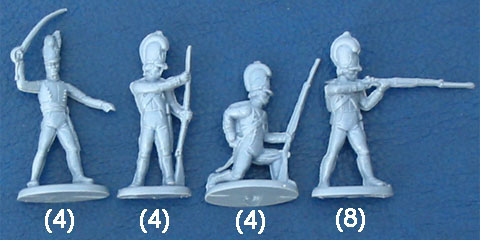
The loading and firing poses are well done, and they can be used to raise wargame units.
Satisfactory casting quality. Obvious flash and mould lines need to be removed prior to painting. The editor used the Rai-Ro ZEP-70 wax carving instrument to blend mould lines into the surface of the model.
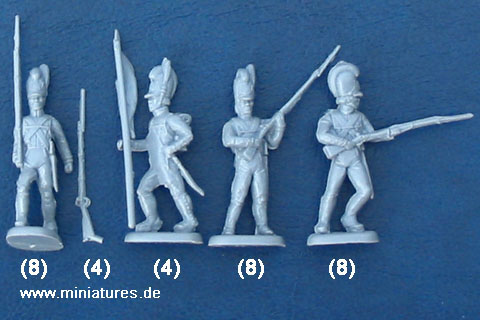
The officer is incorrectly shown wearing a regular enlisted man’s Raupenhelm with the more compact lambskin caterpillar crest. Officers and senior NCOs wore helmets with caterpillar crests made from bearskin which are noticeably thicker, and which protrude straight forward at the front of the helmet. This mistake will be difficult to fix. The officer is not suitable for the popular 1812 and 1813 wargaming periods, because he is wearing the sash which was officially discarded before the invasion of Russia.
Bavarian infantry flags should be 24 mm square in this scale. The separate plastic pennons included in this set are practically useless, they measure only 11 mm square, less than half the size of an infantry flag and nearly twice the size of a cavalry standard. It’s amazing that manufacturers routinely make such silly mistakes, even though reliable historic information is readily available.
The marching NCO and advancing grenadiers exhibit a serious motor coordination problem. These figures are sculpted in a horse’s ambling gait, moving the arm and leg of the same side in unison. If you’ve ever tried this at home or in the military, you’ll know what an impossible gait it is. You just don’t get very far when you walk that way, because the body rotates around the vertical axis. One ambling soldier in a marching formation will quickly cause mayhem, particularly if bayonets are fixed.
The grenadier with open hand is marred by the moulding process: his lower chest and belly are flat, without any detail. Expert painters may fix this problem by painting in the missing details.
Historical Employment
- Bavarian Officers, 1805–1812
- Bavarian Line Infantry Grenadiers, 1807–1815
- Bavarian Line Infantry Schützen, 1811–1815
Conversions
- Bavarian Infantry wearing the Raupenhelm without plume
- Bavarian Line Infantry Füsiliers, 1807–1815
- Bavarian Line Infantry Schützen, 1807–1811
- Bavarian Light Infantry Füsiliers, 1807–1815
- Bavarian Jägers, 1. & 2. Jäger-Bataillon, 1815
- Bavarian Infantry Elites armed with a short rifle
- Bavarian Light Infantry Karabiniers, 1807–1815
- Bavarian Jäger Karabiniers, 1815
- Bavarian Infantry in Greatcoats
Heads with the Bavarian Raupenhelm may be used to convert French infantry in Greatcoats to Bavarian Infantry. Fusilier helmets need to have the plume removed which was only worn by grenadiers and skirmishers of the line infantry battalion.
Bibliography
- Cassin-Scott, Jack: Uniforms of the Napoleonic Wars in Colour 1796–1814, Plate 37
- Haythornthwaite, Philip: Uniforms of 1812, Plate 35
- Knötel-Sieg: Handbuch der Uniformkunde, pp. 50-54
- Pivka, Otto von: Napoleon’s German Allies (4): Bavaria (Lond. 1980)
Wargamers will be happy to have these Bavarian line elite soldiers, even if some conversion is required to convert them to line Füsiliers.