Skirmishers
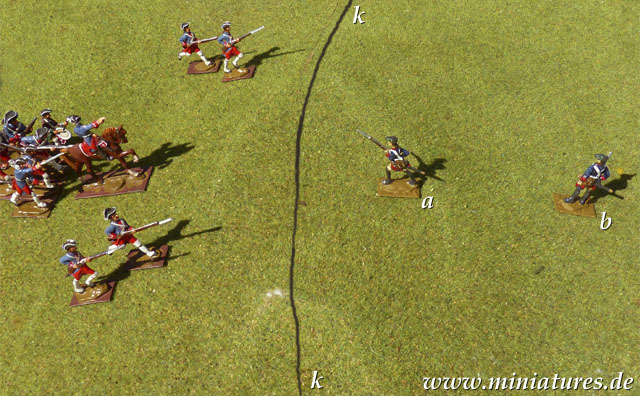
Skirmishers are, in part, those troops sent ahead, to the side or rear of the vanguard, rearguard, or flank guard, both infantry and cavalry, and, in part, the cavalrymen fighting in extended order, particularly called flankers, as well as the tirailleurs of the infantry.
The purpose of skirmishers of the first type is to scout an area to see if the enemy is hidden there, and then immediately inform the detachment from which they were sent, or, if a whole line of such skirmishers is in contact and circumstances make it necessary, to engage the enemy in skirmishing and protect their main force from the enemy‘s sudden onslaught. The following should be observed by these skirmishers:
- Two men are always sent out in pairs, one of whom is called the second of the other, to support him and never lose sight of him.
- They have their pistols cocked and, in the case of infantry, the frizzen stall of their musket or rifle removed. They carefully question everyone they encounter to determine if any enemy activity has been observed in the area; if so, one of them immediately reports what he has heard to the commander of the squad from which he was detached.
- They turn around and look back at their squad from time to time to ensure they never stray too far. As soon as they reach a small thicket, small village, or isolated farmstead, one man stays at the entrance while the other thoroughly searches everything. If, however, these objects cannot be searched by one man due to their size, one of them must get help from the squad. When they reach hills, one man goes up to survey the area, while the other remains at the foot, keeping a close eye on his comrade.
- If two skirmishers come to a sunken lane, one should remain at the entrance until the other has searched it. Then it is best if they both try to climb the embankment on either side and proceed alongside the sunken lane, scouting everything on either side. On main roads, and also on smaller, tree-lined paths, they should keep to both sides. At bridges and fords, where they cannot properly see the terrain on the opposite bank, one should remain there until the other has confirmed that there is nothing to fear beyond.
- When the skirmishers reach a larger village, one of them first inquires about any enemy within. Then both can pass through, but they position themselves on the other side in a spot where they can observe everything until the vanguard, which has meanwhile arrived at the village, has examined it more closely. Only then do they continue their march.
- At night, the skirmishers on the plains move to the side of the main body, keeping it within sight. By day, they stay close to the main body and are only sent to the right and left to investigate a bush, a depression, a house, etc., located some distance away. When marching through an area crisscrossed by hedges, the skirmishers on both sides, both by day and by night, proceed along side paths that lead back to the main road; they do not stray more than 1500 paces from the main body if possible.
- If the skirmishers spot the enemy at a distance, they try to remain undetected, and one of them reports this to the main body. If it is merely an enemy patrol, they try to cut it off to take prisoners and thus obtain information. However, if the skirmishers encounter the enemy unexpectedly, they fire and withdraw to their main body. As soon as a skirmisher spots the enemy on the flank and sees them advancing on the main body, he also opens fire, and then everyone likewise assembles at the main body.
- If the enemy, after we have been discovered, slowly advances, and it is feared that he has support, or if the enemy is stronger, then one engages him in skirmishing, and the poorly mounted men are sent back. The infantry also skirmishes with him. The skirmishers of the various detachments, such as the flank patrols, vanguard, etc., must then try to maintain contact as much as possible, from which a proper skirmish en débandade will develop, and the detachment will have time either to send reinforcements to the skirmishers or to form up into battle order itself.
Skirmishing in the Cavalry
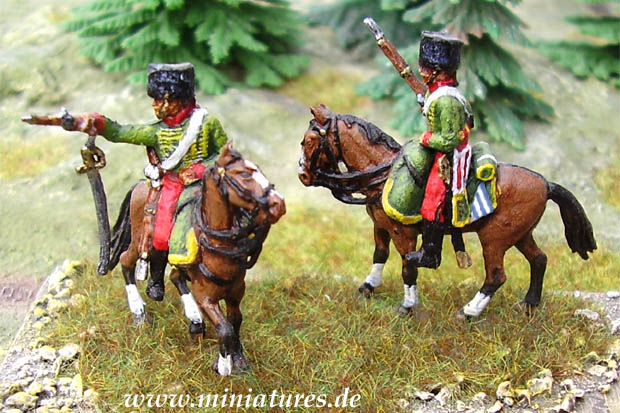
The primary purpose of cavalry skirmishing, or flanking, is to observe the enemy during the engagement and prevent individual men from advancing. If a cavalry line is to be covered by flankers both in place and while moving forward and backward, the fourth platoon of the squadron (in the Prussian army) is generally used for this purpose. It advances at a trot approximately 150 to 200 paces in front of the center of the squadron, and from there sends forward the four rotas of the left wing, or more depending on the circumstances, as flankers, once again at a distance of 100 paces. Of these, 2 are riflemen; the six flankers cover the front of the squadron in a single rank; 20 to 30 paces behind them, the riflemen form a second line. The flankers draw their carbines or pistols and are separated into numbers 1 and 2, the corresponding numbers always supporting each other, and therefore, in ordinary cases, one does not shoot until the other has loaded. The riflemen have the obligation to support all flankers with their steady fire, and always rush to where they can be of use; they also dismount from their horses when the opportunity arises, in order to shoot more accurately. – Each squadron has a skilled non-commissioned officer designated to lead the flankers; this NCO remains in the line of riflemen but always rushes to wherever he can be of use, and also carefully observes the enemy‘s actions in general, reporting them immediately to his officer. The following are the main rules for flanking:
- For this, the most skilled and prudent people are chosen, as well as the fastest horses. Two men are always assigned together, never separating, and must constantly second one another.
- All the flankers keep as much in a line as possible, always two by two, at intervals of 15, 20, or more paces, depending on the terrain. Behind them, at approximately 200 to 400 paces, are squads in close order who act as the soutien for the skirmishers and move forward or backward with them as needed. Everyone must be very attentive to their leader and follow his signals precisely; therefore, no one may stray more than 200 paces from him.
- The closed order squads, which serve as soutiens for the flankers, also keep 200 to 400 paces apart and support each other in such a way that if one retreats, the other faces the enemy; if one charges the enemy while skirmishing, the other positions itself to cover any retreat of the former.
- The skirmishers must be in constant motion, because anyone who stands still is more likely to become a target for the enemy shooters. If a single combat ensues, they must position themselves so that the enemy always remains on their right. The first rides forward to pistol range, and positions himself as if about to fire. If the enemy fired, he approaches even closer, fires back, and then draws his saber. Now his second approaches, following the same procedure until the other has reloaded. The pistols are loaded with two bullets, chopped in half. Apart from the skill of the rider, the speed and agility of the horses determine victory in skirmishes.
- If the enemy retreats, the skirmishers advance, but maintain their position more on the flanks to allow our troops to attack. Occasionally, several skirmishers unite, attack the nearest enemy skirmishers, and pose as if they were about to charge the soutien. If the enemy is about to pass through a defile, this is an advantageous time to attack the last ones who have not yet passed. Others try to circumvent the defile to threaten those who have already passed. However, one must always assume that the enemy might lay traps for us, perhaps luring the skirmishers into infantry fire or falling upon us with previously concealed troops.
- If the skirmishers are attacked so heavily that they can no longer hold their ground, especially by squads in close order, they withdraw to their soutiens, but positioning themselves on their flanks to attack the enemy‘s flank if he advances further. If the skirmishers are pursued while retreating, one fires while his second rides back and reloads; then the former rides back, and the latter fires. During the retreat, every possible trap must be laid for the enemy.
- Since every man is left to his own devices when skirmishing, the most precise and detailed training is essential in peacetime. They must be able to ride perfectly and guide their horses so that they always remain on the enemy‘s right side when the enemy circles them; they must learn to fence against each other with thick sticks, equipped with baskets, and also practice firing blancs at each other to assess their ability to wait for the right moment.
Source: Rumpf, H. F.: Allgemeine Real-Encyclopädie der gesammten Kriegskunst (Berl. 1827)