Modern US Infantry
Revell 1:72 Scale Figure Review
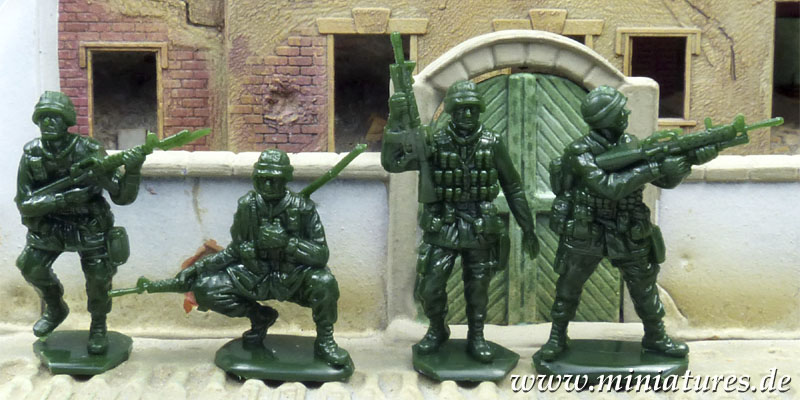
Revell 1:72 scale Modern US Infantry wearing Battle Dress Uniform (BDU) with M.1981 Woodland Camouflage, protective vest and combat helmet of the Personnel Armor System for Ground Troops (PASGT) introduced in 1983, and All-Purpose Lightweight Individual Carrying Equipment (ALICE) introduced in 1973, which was replaced by Modular Lightweight Load-carrying Equipment (MOLLE) in 2001.
Contents
48 Figures in 12 Poses – 25 mm equal 180 cm Height
- Radiotelephone Operator with M16 Rifle and Binoculars, squatting (3)
- Anti-Tank Gunner with M47 Dragon ATGM, in Firing Position (2)
- US Soldier with M16 Rifle and 84 mm AT4, advancing (4)
- Machine Gunner with M60 LMG, advancing (3)
- Automatic Rifleman with M249E1 SAW, prone, firing (5)
- Automatic Rifleman with M249E1 SAW, kneeling (5)
- Grenadier with M16 and M203 grenade launcher, advancing (5)
- Grenadier with M16 and M203 grenade launcher, firing (5)
- US Soldier with M16, sitting, firing (4)
- US Soldier with M16, prone (4)
- US Soldier with M16 and M9 Bayonet, running (4)
- US Soldier with M16, throwing Hand Grenade (4)
Evaluation
Good choice of subject, Revell‘s Modern US Infantry is compatible with ESCI‘s Modern US Soldiers. The RTO, anti-tank gunner, the two grenadiers, and the machine gunner are repetitions of similar ESCI poses which might have been put to much better use like the FGM-148 Javelin, M224 60 mm Mortar, and M24 Sniper Weapon System.
Revell sculpted the RTO in a very uncomfortable pose, forever squatting on the battlefield, holding his M16 in one hand, and binoculars in the other. It looks like Revell rolled a two-man FiST (Fire Support Team) or a Tactical Air Control Party (TACP) into just one figure, when there should be two, the Forward Observer (FO) or Joint Terminal Attack Controller (JTAC) with binocular and laser range finder, assisted by an RTO with manpack radio. A two-man team would have been the better choice here, and there might have been enough room on the sprue had Revell not duplicated so many poses already covered in the older ESCI Modern US Soldiers set.
The advancing grenadier is so similar to his colleague in the ESCI figure set, his only redeeming quality is the fact that the M16 rifle is sculpted correctly, rather than being the “heroic”, vastly over-sized weapon we have come to expect from ESCI.
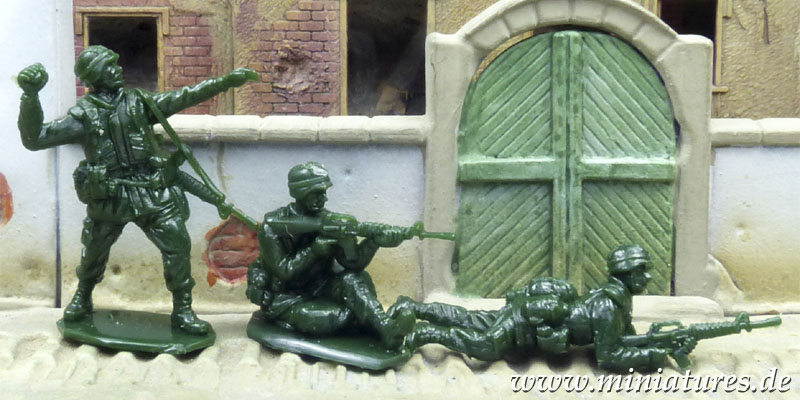
The figures are too tall to represent US soldiers, who are an average of 2 to 3 inches shorter than northern Europeans. The 1990s was the decade when American height growth plateaued. Dietary habits are likely to blame for this development, as “caloric intake” increased, but “nutrient density” decreased.
The M9 bayonet of the running rifleman, introduced in 1986, and the ALICE gear, replaced by MOLLE in 2001, allow us to place this figure set in a historical context.
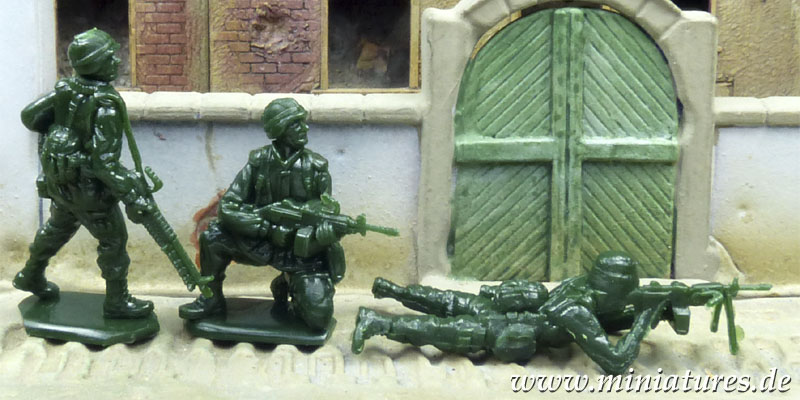
The two M249 Squad Automatic Weapon (SAW) poses are a welcome addition to this set. The SAW entered service in 1984, so was not included in the compatible ESCI set of Modern US Soldiers which appears to be based on the 1983 US Invasion of Grenada.
While the advancing M60 machine gunner is a nice figure, ESCI had already covered this subject with two excellent M60 light machine gunners, and Revell might have used this pose to fill another gap in the line.
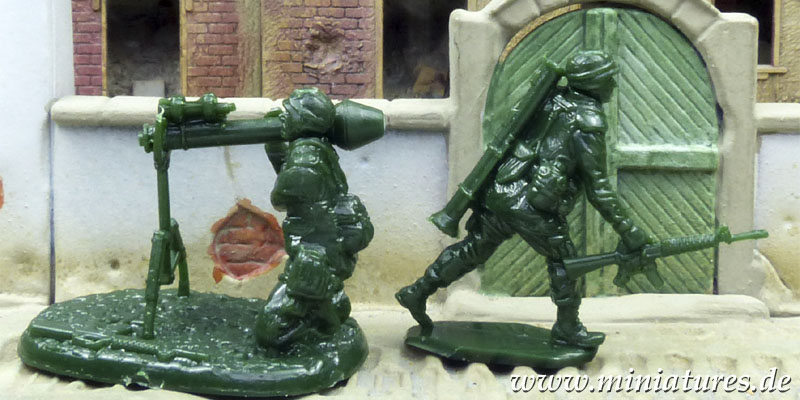
The bipod yoke of the M47 Dragon anti-tank guided missile system needs to be bent back at a 45° angle so that the tracking control assembly (TCA) guidance system comes closer to the anti-tank gunner‘s face. These delicate parts will have to be welded together to achieve a secure bond.
The 84 mm AT4 “eighty-four” disposable anti-tank launcher variant of the Carl Gustaf 8.4 cm recoilless rifle is in service in many NATO and allied countries around the world, making this particular figure suitable for inclusion in a number of different wargame armies. A simple head swap may be required in some cases, to make the figure blend in.
Historical Employment
- US Infantry (Army/Marines), 1986–2001
- US Invasion of Panama, 1989–1990
- Gulf War, 1990–1991
- US Intervention in the Somali Civil War, 1992–1995
- NATO intervention in Bosnia and Herzegovina, 1992–1995
- Intervention in Haiti, 1994–1995
- NATO Intervention in Kosovo War, 1999
- War in Afghanistan, 2001–2021
Possible Conversions
- Modern U.S. infantry with beret
- U.S. Special Forces wearing the green beret instead of the helmet
- Airborne wearing the maroon beret instead of the helmet
- Canadian Infantry
- Greek Infantry
- Netherlands Infantry
- Turkish Infantry
- Ukrainian Infantry
Painting Guide
The painting instructions on the back of the box recommend enamel paints which are not really suitable for soft plastic miniatures. Fortunately, the listed paint numbers also match Revell‘s own range of Aqua Color Acrylics.
- Revell 9 »Anthracite«: US M.1981 Woodland Camouflage Pattern
- Revell 16 »Sand«: US M.1981 Woodland Camouflage Pattern
- Revell 35 »Flesh«: Faces, Hands
- Revell 48 »Sea Green«: US M.1981 Woodland Camouflage Pattern
- Revell 84 »Leather Brown«: US M.1981 Woodland Camouflage Pattern
- Revell 86 »Olive Brown«: Webbing, Packs, Pouches
- Revell 91 »Iron«, »Gun Metal«: Gun Barrels, Bayonet
- Revell 302 »Black«: Boots
- Revell 362 »Reed Green RAL 6013«: Intrenching Tool Carrier
- Revell 378 »Dark Grey«: M16 Plastic Parts
Revell 86 »Olive Brown« works only for the LC-1 field first aid dressing case, which was Olive Green № 106 (OG106); the rest of the US Army all-purpose lightweight individual carrying equipment (ALICE) needs to be painted Olive Drab № 7 (OD7).
To account for aerial perspective, we never use black to paint black items of uniform or equipment. Revell 9 »Anthracite« and Revell 302 »Black« are practically the same colour, and they are booth too black to be used on 1:72 scale miniatures.
Revell 1:72 scale Modern US Infantry is a must-have for wargamers interested in raising US, NATO or western allied infantry platoons.